




- What are cellulose ethers?
- Industrial production of cellulose ethers
- Chemical-physical properties of cellulose ethers
- Applications of cellulose ethers in construction
- Use of cellulose ethers in the paint industry
- Cellulose ethers in polymers and composite materials
- Technical and ecological advantages of cellulose ethers
- Recycling and biodegradability of cellulose ethers
From Synthesis to Sustainability: The Role of Cellulose Ethers in Construction, Paints and Advanced Polymeric Materials
by Marco Arezio
The search for high-performance polymeric materials with a low environmental impact has led, in recent decades, to a growing interest in cellulose derivatives.
Cellulose is the most abundant natural polymer on Earth, a renewable resource extracted from wood, cotton and other fibrous plants. Through targeted chemical processes, cellulose is transformed into a wide range of cellulose ethers, including methylcellulose (MC), hydroxyethylcellulose (HEC), hydroxyethylmethylcellulose (HEMC) and hydroxypropylmethylcellulose (HPMC). These materials, thanks to their unique properties, have revolutionized the construction, paint and even advanced polymer industries.
What are cellulose ethers?
Cellulose ethers are derivatives obtained through an etherification reaction of raw cellulose. In practice, some hydroxyl groups (-OH) of the glucosidic units of cellulose are replaced by alkyl or hydroxyalkyl groups, which modify the solubility and rheological properties of the starting polymer. This process allows to obtain materials that, while maintaining the basic structure of cellulose, acquire new functionalities: they become more easily soluble in water, more stable and more versatile in industrial processes.
Cellulose ethers are not only technically advanced materials, but also represent an ecological solution. In fact, their production starts from renewable resources and, compared to many synthetic polymers of fossil origin, has a potentially lower environmental impact.
How cellulose ethers are produced
The production of cellulose ethers involves several steps, all carried out under controlled industrial conditions:
- Cellulose preparation: cellulose is first purified, eliminating lignin and hemicelluloses through bleaching and hydrolysis processes. The starting material can be wood pulp, cotton or plant residues of various origins.
- Activation: Cellulose is treated with an alkaline solution (usually sodium hydroxide), which makes the hydroxyl groups more reactive.
- Etherification: in this phase the etherifying reagent is introduced (for example methyl chloride for methylcellulose, ethylene oxide for hydroxyethylcellulose, propylene oxide for hydroxypropylmethylcellulose). The degree of substitution, i.e. the quantity of ether groups introduced, is precisely controlled, since it directly influences the properties of the final product.
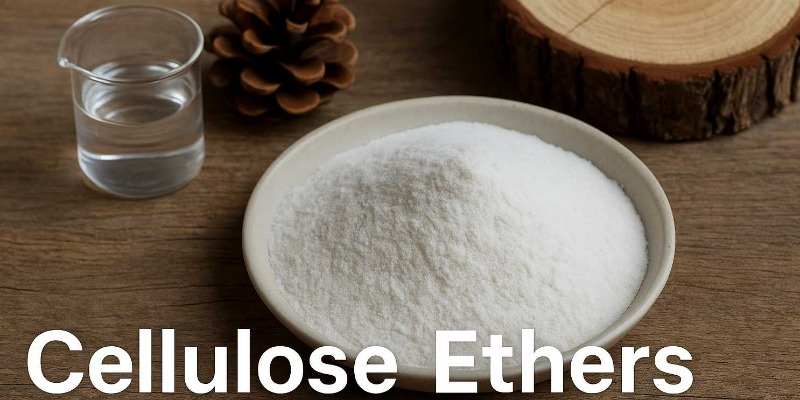
- Neutralization and purification: the reaction mixture is neutralized, washed to remove by-products and finally dried. The resulting product is a white, odorless, fine-grained, highly pure powder.
- Quality control: Product characteristics – moisture, ash content, bulk density, viscosity and pH – are rigorously monitored, as they influence performance in different applications.
Uses of cellulose ethers in industry
Cellulose ethers are now a mainstay in many industrial sectors, mainly due to their ability to modify the rheology and processability of numerous materials.
Building
In adhesives, cement mortars, fillers and cement-based products, the addition of cellulose ethers (especially hydroxyethyl methylcellulose, HEMC) improves workability, increases water retention and adhesive strength, and reduces slippage. This translates into easier and more efficient applications, as well as greater durability of the finished product. The ability to “hold” water in cementitious systems allows for better hydration and a more complete reaction of the binder, a key factor in the final quality of constructions.
Paint industry
In waterborne paints and decorative coatings, cellulose ethers are used as thickeners, stabilizers and suspending agents. In addition to ensuring uniform application, they prevent pigment settling and improve the appearance of the painted surface.
Polymers and composite materials
In recent years, research has focused on the use of cellulose ethers as rheological modifiers and compatibilizing agents in biodegradable polymers.
Some studies have shown that, inserted into matrices such as polylactic acid (PLA) or other biopolymers, cellulose ethers improve filler dispersion, mechanical stability and material processability, paving the way for new applications in composite materials and sustainable packaging.Other sectors
Cellulose ethers are also used in pharmaceuticals (as excipients and controlled release agents), in the food industry (as thickeners and stabilizers) and in the production of detergents, cosmetics and personal care products.
Technical and performance advantages of cellulose ethers
The large-scale adoption of cellulose ethers is motivated by a number of key advantages, supported by a vast scientific literature:
- Excellent bond: improves the adhesion of mortars and fillers to the application surfaces.
- Increased water retention: they delay evaporation, ensuring longer working times and a better chemical reaction in the mortars.
- Slip resistance: makes it easier to apply materials on vertical surfaces without dripping.
- Flexibility and ease of use: powders easily dispersible in water, compatible with many chemical systems.
- Environmental compatibility: starting from a renewable natural base, they fit perfectly into circular economy models and green building projects.
Cellulose ethers and recycling: between biodegradability and circularity
One of the central themes in current research concerns the end-of-life of cellulose ethers and their compatibility with recycling processes. Although they are natural derivatives, the presence of ether groups modifies their biodegradability compared to pure cellulose.
However, numerous studies have confirmed that many cellulose ethers, particularly those with low degrees of substitution, are nevertheless biodegradable under controlled environmental or industrial conditions (e.g. composting).
In the industrial field, the possibility of reusing production waste or residues of cellulose ethers in new production cycles is becoming a reality, also thanks to the adoption of depolymerization processes or reuse in low environmental impact mixtures. In particular, the use of these materials in biodegradable polymer composites represents an interesting opportunity for “upcycling”, that is, the valorization of a residue in a higher quality product.
Conclusions: Towards a sustainable supply chain of natural polymers
Cellulose ethers embody a perfect balance between technology, sustainability and industrial performance. Their versatility, renewable origin and recycling prospects make them one of the most promising solutions for green construction, sustainable paints and innovation in advanced polymeric materials.
In an era in which the demand for high-performance and at the same time ecological materials is increasingly pressing, cellulose ethers represent a concrete answer, supported by a solid scientific basis and by applications now consolidated in the manufacturing world.
© Reproduction prohibited
Main sources
R. M. Rowell, “Handbook of Wood Chemistry and Wood Composites” (CRC Press, 2022).
G. Heinze, “Cellulose Derivatives: Synthesis, Structure, and Properties,” in Polysaccharides, 2021.
Y. Habibi et al., "Cellulose-Based Hydrogels: Synthesis, Properties and Applications," Carbohydrate Polymers, vol. 261, 2021.
M. Vehviläinen et al., "Biodegradation of Cellulose Ethers in Industrial Composting," Waste Management, 2023.
S. Gurgel et al., "Recent Advances on the Use of Cellulose Derivatives in the Building Industry," Construction and Building Materials, vol. 315, 2022.
European Polysaccharide Network of Excellence (EPNOE), "Cellulose Ethers: Environmental Impact and Industrial Use," Technical Report, 2023.