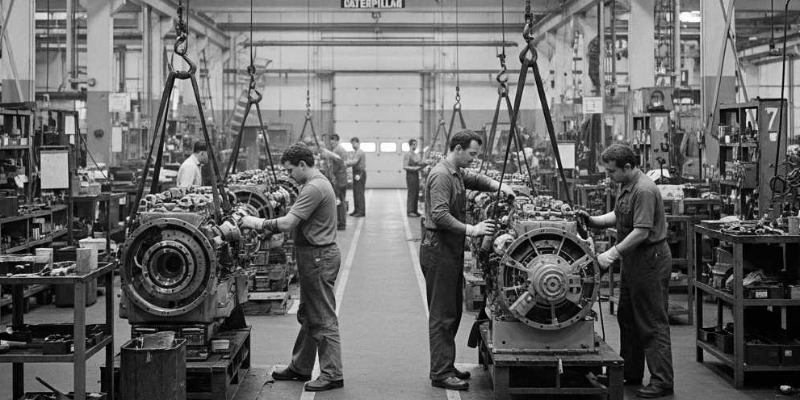
- Caterpillar Reman 1973: Birth of a Sustainable Model
- The Economic Context of 1973 and the Caterpillar Vision
- Design for Disassembly: Caterpillar's Intelligent Design
- Guaranteed Remanufacturing: The Reliability of Caterpillar Remanufacturing Products
- New Careers: The Employment Impact of Remanufacturing
- Caterpillar Reman's Legacy in the Circular Economy
- From Iowa to the World: The Expansion of Caterpillar Reman
- Caterpillar Reman: A Case Study of Sustainable Success
Discover how Caterpillar transformed "remanufacturing" into a winning business model in 1973, anticipating the circular economy, design for disassembly, and new job opportunities
By Marco Arezio
Caterpillar Reman 1973: The Silent Revolution That Redefined Industry.
In the heart of Iowa, in 1973, a titanic company like Caterpillar took a bold and far-sighted step, destined to redefine not only its own future but the entire concept of industry: the opening of its first large plant dedicated to remanufacturing diesel engines. What might have seemed like a gamble at the time is now a strategic pillar, an ecosystem employing over 3,600 people and managing more than 8,000 product codes. The birth of Caterpillar Reman was not just a simple production expansion; it was the dawn of a new paradigm, a pragmatic response to the growing demands for efficiency, sustainability, and value in the heavy machinery sector.
The Context of 1973: Crisis, Efficiency, and Necessity
1973 is a symbolic year, often remembered for the oil shock that shook the foundations of the global economy. In this climate of uncertainty and growing awareness of resource scarcity, the search for solutions that optimized material use and extended product life became not just an option, but an urgent necessity. Caterpillar, with its strategic vision, seized the opportunity to capitalize on a simple but powerful insight: instead of discarding worn components, it was possible to restore them to "like new" or even better conditions, reducing costs for customers and environmental impact.
The idea of "remanufacturing" wasn't entirely new. For decades, mechanical workshops and small businesses had been repairing and replacing worn parts. However, the scale of Caterpillar's investment and its decision to industrialize the process, applying rigorous quality standards and guaranteeing remanufactured products on par with new ones, was a revolutionary act. This transition marked the shift from a craft-based approach to a genuine integrated production chain, with a clear business vision.
Design for Disassembly: Designing for the Future
One of the cornerstones of Caterpillar Reman's success, and a crucial element for any discussion on the circular economy, is the concept of "Design for Disassembly" (DfD). Although the term wasn't widely used with the same resonance in 1973 as it is today, the philosophy was intrinsic to the project. To efficiently and profitably remanufacture a diesel engine, it's fundamental that it was conceived from the outset to be easily disassembled, with accessible and reusable components.
Caterpillar, leveraging its engineering expertise, began integrating the consideration of a product's end-of-life into its design processes. This didn't just mean facilitating the replacement of a single part, but thinking of the entire assembly as a system of modules that could be recovered, cleaned, inspected, and, if necessary, refurbished with targeted interventions. This foresight allowed for maximizing value recovery from engine "cores," transforming them from waste into valuable resources. DfD is a striking example of how innovation lies not only in creation but also in the intelligent management of product lifecycles.
Warranty Models: Building Trust in the "Remanufactured"
The success of a large-scale remanufacturing operation largely depends on the ability to instill customer trust. Traditionally, "remanufactured" products might have been perceived as second-rate, with lower quality than new ones. Caterpillar addressed this challenge proactively by implementing robust warranty models that equated remanufactured products with new ones.
This strategic decision was not trivial. It required significant investment in quality processes, rigorous testing, and meticulous control of every remanufacturing stage. The goal was to ensure that a remanufactured Caterpillar engine not only performed like a new engine but offered the same reliability and durability. This warranty policy not only reassured customers but also sent a strong signal to the market: Caterpillar's remanufacturing was not a fallback solution, but an intelligent and sustainable choice, capable of offering excellent performance at a lower cost and with reduced environmental impact.
New Occupational Sectors: An Innovative Supply Chain
The opening of Caterpillar's remanufacturing plant was not only an engineering and commercial triumph; it was also a catalyst for the creation of new occupational sectors. The remanufacturing process requires specialized skills that go beyond simple assembly or basic repair. It needs expert technicians in wear diagnosis, precision cleaning, high-tolerance mechanical processing, assembly of remanufactured components, and final testing.
These roles gave rise to new professions, enriching the job market and creating opportunities for highly specialized individuals. Today, with over 3,600 employees dedicated to this activity, Caterpillar Reman demonstrates how the circular economy can be a powerful driver for economic development and the creation of skilled jobs. It's a tangible example of how sustainability is not just a cost, but an opportunity for social and economic innovation.
The Legacy of Caterpillar Reman: A Model for the Future
Over fifty years after its inauguration, Caterpillar Reman's plant in Iowa continues to be a beacon in the world of the circular economy. Its impact extends far beyond the impressive numbers of remanufactured products or employees. It's an exemplary case study that demonstrates how a proactive approach to sustainability can generate a lasting competitive advantage.
Caterpillar Reman anticipated trends that are now at the center of global debate, such as the need to reduce the ecological footprint, resource valorization, and the importance of a longer, more responsible product lifecycle. Its story is a testament to how innovation can emerge from the ability to see value where others see only waste, and how foresight can transform an intuition into a thriving and sustainable business. In an era where "throwaway" culture is giving way to more responsible models, Caterpillar's 1973 lesson resonates more than ever, inviting other industries to follow suit and rewrite the rules of the game with a circular mindset.
© Reproduction Prohibite