- What it really means to produce biobased packaging from organic waste
- Why the comparison with biobased crops is crucial
- Which organic waste can become raw material for packaging?
- The main technologies for obtaining polymers and films from biological waste
- The real environmental advantage of organic waste compared to crops
- Where the sustainability of packaging waste is concrete and measurable
- Industrial limitations that should not be hidden
- Technical performance and quality of packaging obtained from waste
- Food safety, traceability and European rules
- Why the future of credible biobased comes from waste and not from fields
How to transform organic waste into truly circular packaging materials, reducing land use, food competition, and hidden environmental impacts
Author: Marco Arezio. Expert in circular economy, polymer recycling, and industrial processes for plastics. Founder of the rMIX platform, dedicated to enhancing recycled materials and developing sustainable supply chains.
Date: April 10, 2026
Reading time: 12 minutes
In the debate on sustainable packaging, the term biobased is often used in an overly generic way. In reality, it is not enough for a material to come from biomass for it to be considered, in itself, an environmentally convincing solution. The European Commission itself makes it clear that a biobased plastic is simply a plastic made wholly or partly from biological resources, and that this does not automatically imply either biodegradability or compostability; moreover, the environmental benefit must be assessed across the entire life cycle, including the effects on land use.
This clarification is fundamental because it makes it possible to distinguish between two very different industrial models. The first is that of biobased packaging obtained from dedicated crops, that is, from sugars, starches, or other primary biomasses grown specifically to become industrial raw materials. The second, much more consistent with the logic of the circular economy, is the one that uses already existing organic waste and biological by-products: source-separated food waste, agro-industrial residues, lignocellulosic fractions, fruit and vegetable processing waste, protein residues, or polysaccharide-rich residues from the food industry. It is above all this second model that deserves attention today, because it makes it possible to replace part of fossil carbon without creating new pressure on primary agricultural resources.
In other words, when speaking about truly sustainable biobased packaging, the issue is not only “where the carbon comes from,” but whether obtaining it removes land, water, fertilizers, and primary biomass from other more valuable or more delicate uses. Precisely for this reason, the European Commission, in its policy framework on biobased plastics, states that producers should give priority to the use of well-managed organic waste and by-products rather than primary biomass; and the text of the communication also emphasizes that, especially for short-life products such as many packaging items, waste and by-products should be preferred over primary biomass.
Why the comparison with crop-based biobased materials is decisive
For years, part of the market has presented biobased materials as an almost automatically virtuous alternative to fossil plastics. Today we know that this view is too simplistic. A study published in 2026 in Nature Communications shows that the transition toward bio-based packaging can indeed reduce climate-altering emissions, but it can also increase damage to ecosystems, above all because of land use; moreover, the results depend greatly on the origin of the biomass and on end-of-life management. The implicit conclusion is clear: not all biomass is the same, and the difference between primary biomass and biological waste is environmentally decisive.
The European Commission also insists on this point when it reminds us that the benefit of biobased materials must be evaluated beyond the simple reduction in the use of fossil sources, explicitly including changes in land use. The JRC, in its 2026 policy brief, adds that replacing fossil carbon with biomass generally lowers greenhouse gas emissions over the life cycle, but that significant trade-offs emerge in other environmental categories. Translated into industrial terms: biobased packaging obtained from dedicated crops may have an interesting climate profile, but that does not make it the best overall ecological option.
This is where organic waste radically changes the picture. When the feedstock comes from biomass that has already been discarded by the economic system—for example food residues or processing by-products—the conflict with food production, feed production, land use, and part of the agricultural inputs required for primary cultivation is avoided or drastically reduced. A European Commission report on the urban bioeconomy highlights precisely that flows of urban biowaste and biological sludge can constitute secondary feedstocks available all year round and usable in biorefineries without creating conflict with food production or land-use change.
Which organic wastes can become raw materials for packaging
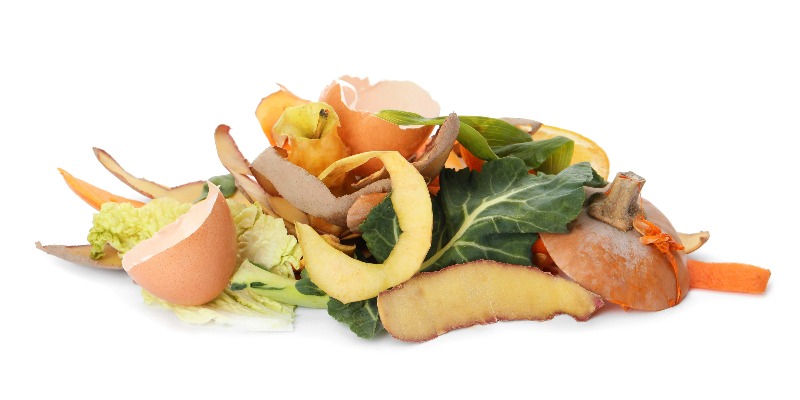
Not all organic waste is equally suitable for packaging production. From a technical point of view, the most promising flows are those that are relatively homogeneous, clean, and traceable, because they make it possible to better control composition, contaminants, yields, and the properties of the final material. This category includes above all waste from the agri-food industry: peels, pulps, pomace, bagasse, starchy waste, lignocellulosic residues, protein by-products, and fractions rich in pectins, cellulose, hemicellulose, or other functional biocomponents. The most recent scientific reviews on packaging from agro-waste confirm that these flows can be valorized to extract cellulose, hemicellulose, starch, pectin, lignin, chitosan, alginate, and PHA, with applications in films, coatings, active structures, and biodegradable packaging.
A second very interesting category consists of source-separated food waste, that is, food waste collected selectively and not dispersed into mixed municipal waste. A 2024 LCA study published in Sustainability considers precisely separated food waste as a second-generation feedstock for bioplastic production, highlighting the advantage of not competing with the food sector. This is an important shift because it moves the discussion away from simple “renewable biomass” toward the valorization of a loss within the food system.
More complex, however, is the case of mixed urban organic waste. The European Union considers it a stream with still largely untapped potential for higher value-added bio-based products, but acknowledges that truly mature large-scale industrial activities are still few. Its valorization into packaging is therefore possible, but it requires collection quality, sorting, and logistics that are far more rigorous than those needed for compost or biogas.
The main technologies for obtaining polymers and films from biological waste
There is not just one industrial route. The first consists of the direct extraction of biopolymers or biocomponents from waste. From agro-food residues it is possible to obtain matrices or functional ingredients for films and coatings: cellulose for reinforcement and barrier properties, pectins for edible films or coatings, residual starches for thermoplastic matrices, lignin to modify barrier or UV properties, chitosan from crustacean waste for antimicrobial functions. The most up-to-date reviews show that these materials, if properly formulated, can improve the mechanical properties, barrier performance, and active functions of packaging.
The second route is the biotechnological one, in which organic waste is first converted into intermediate molecules or directly into polymers through fermentation. The most studied case is that of PHAs, microbial polyesters obtainable from different waste matrices. Reviews from 2024 and 2025 dedicated to food packaging show that PHAs are among the most promising platforms for linking organic waste, biotechnology, and packaging, but also that critical issues remain in terms of cost, brittleness, thermal processing window, and processability.
A third route, more properly linked to the biorefinery concept, consists in transforming organic waste into monomers or building blocks that are then polymerized or incorporated into composite systems. The 2025 literature on biorefineries highlights that this industrial architecture makes it possible to reduce waste, create more products from the same matrix, and improve economic efficiency, but it also involves more complex processes, greater investment, and a strong dependence on downstream efficiency.
The real environmental advantage of organic waste compared with crops
The most important advantage of organic waste as a feedstock for packaging does not lie only in the fact that it “does not come from oil.” It lies in the fact that it does not require a new dedicated biological production upstream. This reduces the risk of occupying agricultural land, additional irrigation demand, the use of fertilizers and pesticides, and competition with food and livestock supply chains. The European Commission states this explicitly: the use of organic waste and by-products to produce biobased plastics can help partially decouple the sector from fossil resources, while at the same time reducing the use of primary biological resources and avoiding pressure on biodiversity.
A second advantage, often underestimated, is added to this logic: the prevention of emissions linked to the failure to properly treat organic waste. In the case of food waste, its valorization into materials can prevent it from ending up in landfill or in low-value management streams. The Greek pilot study published in 2024 shows that converting food waste into bioplastic has a dual preventive effect: on the one hand, the waste is diverted from landfill; on the other hand, the production of the equivalent primary biomass, in that case corn, is avoided. In the system analyzed, 715 kg of food waste diverted from landfill corresponded to a reduction of 26.8 kg of methane emissions, while the overall scenario showed benefits in terms of climate, land use, and aquatic ecotoxicity, albeit with limitations linked to the energy consumed in the process.
From a circular economy perspective, the advantage is even clearer. The EU Waste Framework Directive confirms the waste hierarchy and the priority of options that better preserve value and resources. If high-quality organic waste can be transformed into material, and not only into energy or low-value biological treatment, it is shifted toward uses that are more consistent with an advanced circular bioeconomy. The Commission itself is promoting industrial pathways specifically aimed at valorizing urban biowaste into higher value-added bio-based products.
Where the sustainability of waste-based packaging is concrete and measurable
Saying that packaging made from organic waste is “more sustainable” makes sense only if it is specified in what way it is so. The first indicator is the absence of competition with food. Materials made from separated waste or by-products do not divert raw materials from food uses and do not, in principle, require a dedicated expansion of agricultural land.
This makes them environmentally more consistent than crop-based materials, especially in fast-turnover sectors such as single-use or short-life packaging.The second indicator is the lower upstream impact burden. LCA literature does not allow for absolute simplifications, but it converges on one point: when the feedstock comes from waste, a significant part of the impacts associated with primary cultivation is avoided or reduced. The food waste-to-PLA case study shows precisely that environmental benefits arise from the combination of avoided landfill disposal and avoided production of equivalent corn. This does not mean that every waste-based plant automatically wins, but that the structure of the comparison starts from a more favorable basis than materials obtained from primary biomass.
The third indicator is systemic coherence. If Europe made separate collection of biowaste mandatory by December 31, 2023, with substantial implementation from January 1, 2024, it is precisely because organic waste must no longer be considered a marginal residue but a resource to be managed in a qualified way. In this context, using biowaste to create packaging materials can represent one of the most advanced forms of valorization, provided that the system is technically sound and does not slip into greenwashing.
The industrial limits that should not be concealed
Sustainable does not mean simple. Biobased packaging obtained from organic waste presents real limitations that must be acknowledged with technical honesty. The first is feedstock variability. A well-defined industrial residue can be managed; an irregular, contaminated, or poorly collected urban organic fraction is far less manageable. For this reason, the most credible industrial projects tend to start from by-products or high-quality separated streams, not from unsorted municipal organic waste. European initiatives on the valorization of urban biowaste emphasize both the great potential and the fact that large-scale industrial activities are still limited.
The second limitation is energy- and plant-related. The LCA study on food waste highlights that electricity is the main contributor to several categories of environmental impact in the production of PLA from food waste; in particular, the main residual impacts concern freshwater eutrophication, water use, and ecotoxicity, and depend significantly on the energy mix and on the use of process chemicals. Therefore, packaging from organic waste is more credible than crop-based packaging, but only if it is produced in efficient plants, with low-carbon energy and well-optimized separation and purification processes.
The third limitation concerns performance. Reviews on PHAs for food packaging and on materials from agro-waste remind us that, although promising, many of these systems require blending, plasticization, reinforcement, multilayer structures, or functionalization to achieve the required performance in terms of barrier properties, sealability, thermal stability, and mechanical strength. In essence, organic waste can be an excellent feedstock, but the final result depends on material engineering, not only on the ecological virtue of the raw material.
Technical performance and quality of packaging obtained from waste
From the application standpoint, materials derived from organic waste should not be thought of only as “alternative plastics,” but as a broad family of solutions. Some are more suitable for flexible films, others for functional coatings, and still others for trays, inserts, cushioning, laminates, or active packaging. The 2025 literature on agro-industrial residues shows that plant waste can contribute not only to the material matrix, but also to antimicrobial, antioxidant, and barrier properties, helping to extend the shelf life of the packaged product.
This aspect is crucial also from an environmental point of view. Sustainable packaging is not the one that simply “biodegrades,” but the one that performs its function with the lowest overall impact. If packaging made from organic waste reduces the impact of the raw material but worsens food preservation, the final balance may deteriorate. This is why the most promising systems are those that integrate feedstock sustainability, good technical performance, and consistency with actual end-of-life conditions.
Food safety, traceability, and European rules
When these materials enter the world of food packaging, sustainability alone is not enough. They must comply with the European framework on food contact materials. The European Commission reminds us that Regulation (EC) No. 1935/2004 requires that materials must not release components at levels harmful to health and must not alter the composition, taste, or odor of food. In addition, the system requires documentation of compliance, traceability, quality control, and the selection of suitable starting raw materials. This means that packaging from organic waste may be excellent from an environmental standpoint, but it is not automatically suitable for food use without robust industrial and regulatory validation.
On packaging in general, the new European regulation moves in the same direction of rigor. The Commission indicates that the Packaging and Packaging Waste Regulation (PPWR) 2025/40 entered into force on February 11, 2025, and will apply generally from August 12, 2026. This framework does not require the use of packaging made from organic waste, but it raises the bar on design, recyclability, compostability where permitted, and overall environmental consistency. In practice, it narrows the space for materials that are “green in name only” and favors more solid and documentable approaches.
Why the future of credible biobased materials lies in waste and not in fields
The most credible technological direction is not the one that replaces oil with dedicated crops without changing the model, but the one that transforms already existing organic losses into high-value secondary raw materials. This is even more true for packaging, which in most cases is a short-life product. If manufacturing packaging that lasts only a few weeks or months requires occupying agricultural land, using irrigation water, fertilizers, and primary biomass, the environmental advantage risks becoming very fragile. If, on the other hand, that same packaging is produced from well-collected organic waste, from a by-product, or from an industrial waste stream, the reasoning changes radically: value is recovered from residual flows, part of the upstream impacts is avoided, and the bioeconomic conflict between materials, food, and energy is reduced.
The professional conclusion today is therefore quite clear. Yes, biobased polymers and packaging obtained from organic waste are, in general terms, more sustainable than those derived from crops, because they eliminate or mitigate the land-use issue, reduce competition with the agri-food system, and fit better into the European waste hierarchy and the circular bioeconomy. However, this superiority is not automatic: it is truly achieved only when the feedstock is well selected, the process is efficient, the energy is clean, the product is functional, and the end-of-life pathway is coherent. True sustainability, in short, does not arise from the biobased label, but from the quality of the supply chain behind that word.
FAQ
Are biobased packaging materials made from organic waste always compostable?
No. The European Commission clearly distinguishes between biobased, biodegradable, and compostable: a biobased material may be neither biodegradable nor compostable. These are different properties and must be demonstrated case by case.
Can urban organic waste be used directly to make packaging?
Not always directly. Urban waste streams have great potential, but they require high-quality separate collection, sorting, pre-treatment, and more sophisticated industrial processes. Today, the most mature streams for packaging applications remain above all agro-industrial ones and well-separated food waste.
Why are crop-based materials less convincing from an environmental point of view?
Because they may involve land use, pressure on water and agricultural inputs, and conflict with food or feed production. A 2026 study in Nature Communications shows that bio-based packaging can reduce greenhouse gas emissions but increase damage to ecosystems, especially due to land use.
Is packaging made from organic waste automatically safe for food?
No. For food contact, the requirements of Regulation (EC) No. 1935/2004 apply: safety, inertness, traceability, documentation of compliance, quality control, and suitability of the raw materials used in the process.
Does Europe encourage the use of organic waste for biobased plastics?
Yes. At the policy level, the Commission states that producers should give priority to well-managed organic waste and by-products over primary biomass, especially for short-life products. In addition, the separate collection of biowaste has been mandatory in the EU since 2024, creating a stronger basis for advanced valorization supply chains.
Sources
European Commission, Biobased, biodegradable and compostable plastics.
European Commission / Eur-Lex, EU policy framework on biobased, biodegradable and compostable plastics.
European Commission, Food Contact Materials legislation.
European Commission, Waste Framework Directive.
European Commission, Packaging waste / PPWR 2025/40.
JRC, Bio-based plastics in a sustainable and circular bioeconomy.
Nature Communications (2026), Transition to bio-based plastic packaging reveals complex climate–biodiversity trade-offs.
Sustainability (2024), Environmental Impact and Sustainability of Bioplastic Production from Food Waste.
Agricultural and Food Research (2025), Valorization of plant-based agro-waste into sustainable food packaging materials.
Biocatalysis and Agricultural Biotechnology (2024), Advancements in microbial production of PHA from wastes for sustainable active food packaging.
Food Hydrocolloids for Health / ScienceDirect (2025), Polyhydroxyalkanoates for sustainable food packaging.
Licensed image
© Reproduction Prohibited