- The art of reuse: when sustainability becomes creative expression
- Geometries and nature: the visual dialogue between order and chaos
- The tightrope walker and the sun: symbols of balance and rebirth
- Recycled paper and recovered colors: matter as memory
- Chromatic contrasts and symbolic constructions in the composition
- A manifesto for an ethical and conscious art of the future
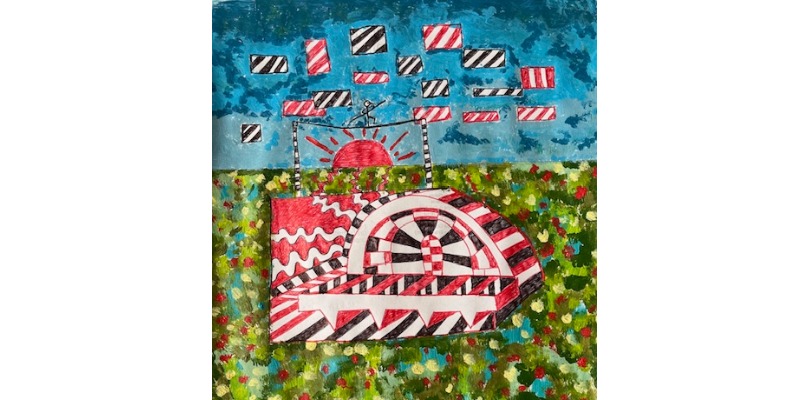
An artwork created on recycled paper with reclaimed colors, telling through geometric and symbolic signs the modern human quest for balance between environment, technology, and spirituality
This work is born from the encounter between sustainability and imagination. The artist, faithful to a principle of respect for resources and creative reuse, chose a recycled paper base, rich in irregular and vibrant fibers — a surface imbued with memory and imperfection. On it, recovered pigments from previous artistic processes were applied: remnants of tempera, acrylics, and inks that, instead of being discarded, find here a new life. It is an act of aesthetic ecology, where nothing is lost and everything is reborn through the language of art.
At first glance, the piece appears playful in its use of geometric motifs, striped patterns, and chromatic contrasts, yet it conceals a profound reflection on human balance in the contemporary world, on uncertainty, and on the fragile harmony between nature, technique, and spirit.
Composition and Visual Language
The image opens onto a field of dense, textured colors, a vibrant expanse of greens, yellows, reds, and blues that, in their spontaneity, seem to pulsate like a living tapestry. The artist paints “in patches,” with quick, layered brushstrokes that evoke the organic movement of nature, a field of flowers that resists containment.
Upon this base rises a visionary architectural structure, composed of red, white, and black lines that evoke both a mechanical construction and a symbolic temple. Geometric shapes — circles, arches, diagonal bands — overlap, creating a visual rhythm charged with energy. The structure is not simply a building or an object: it represents the human-made world, with its rules, balances, and illusions of stability.
From the upper half of the scene, a red sun either rises or sets — the boundary is intentionally ambiguous — behind two striped poles, which seem to support a thin wire. Upon this wire moves a tiny human figure, stylized and minimal, reduced to a simple line: a man or woman in balance, advancing between sky and earth.
Thus, the artist constructs a poetic narrative of risk, instability, and courage — the courage to cross one’s own time.

Symbolism and Interpretation
The work is built upon a continuous dialectic between order and chaos, artifice and nature, light and limitation.
Every element has a metaphorical function:The red and black stripes, repeated obsessively, embody tension — the constant opposition between forces: life and death, passion and control, hope and disillusionment. They are the visual rules of modern man, his need to reduce complexity into patterns.
The sun, positioned behind the structure, becomes a symbol of rebirth and knowledge, but also of latent danger — the light that dazzles and dissolves certainty.
The figure on the wire is the poetic center of the work. Suspended among the striped rectangles of the sky — like fragments of a disintegrating mosaic — and the earthly structure below, it represents the contemporary human being, balancing between the forces of nature and technology, between instinct and rationality, between spirituality and matter.
The flowered field beneath stands for real life — the fertile, chaotic base from which everything emerges. The dabs of color resemble thoughts, emotions, impulses. Yet humankind is now distant from that ground: suspended above it, living in the tension of abstraction.
Material and Sustainability as Poetic Language
The use of recycled paper and reclaimed colors is not a secondary choice but an ethical and poetic act. Each fragment of pigment and each paper fiber tells a story, a past, a second chance. The artist transforms the gesture of recycling into a metaphor for time, in which nothing is destroyed, everything is transformed.
The rough surfaces, uneven thicknesses, and soft transparencies testify to this material history. The artwork thus becomes a meditation on imperfection as value, on the aesthetics of repair, and on the need to accept discontinuity as an integral part of life.
The predominant colors — red, black, and white — recall the visual grammar of Constructivism and Optical Art, yet the artist reinterprets them in a personal, almost naïve style, merging them with the organic irregularity of the landscape. It is a way of saying that modernity can coexist with nature, if contamination and fragility are embraced as part of the creative process.
Balance and Metamorphosis
In the small tightrope walker lies the entire philosophy of the work: to live today means walking a thin line, suspended between the desire to dominate the world and the need to reconnect with the earth. The diagonal stripes, repeated like a visual code, become a rhythmic score of movement — a vibration linking sky and soil.
Though immersed in a surreal dimension, the scene conveys a universal truth: every human being crosses existence like a tightrope walker between light and shadow, birth and sunset, construction and dissolution.
The artist invites us not to fear instability, but to recognize it as the natural condition of being. Balance is not stillness, but perpetual motion. The thin line on which the figure walks does not separate two worlds — it unites them.
Conclusion: A Poetics of Rebirth
Balance on the Edge of the Sun speaks of resilience and transformation, of a world that can still be regenerated through creativity and awareness. Its message is both ecological and existential: if we respect nature and matter, they will return to us the possibility of creating beauty even from remnants, waste, and forgotten things.
The sky, scattered with suspended rectangles, suggests the fragmentation of our contemporary perception, but also the possibility of recomposing a new visual and mental order. It is a sky made of modules and limits, yet it still welcomes sunlight and the fragile human presence.
In its synthesis of geometric abstraction and instinctive painting, of discipline and spontaneity, the artwork becomes a manifesto for the art of the future — one that unites aesthetics and responsibility, matter and meaning.
Each sign, each brushstroke, each reclaimed color is a declaration of faith: that even in a world saturated with waste and dissonance, humanity can still walk the line — in balance — toward a new horizon of light and awareness.
The work is available for sale in a 24x36 cm format. To purchase, please write to info@arezio.it
© Reproduction Prohibited
#MarcoArezio