- Ideological origins of socialist realism
- Art at the service of the Revolution
- Stalin's role in defining official aesthetics
- Monumental architecture and symbolism of power
- Literature, cinema and music under surveillance
- Heroes of work and utopian narratives
- The limits imposed on individual creativity
- The controversial legacy of socialist realism
How Socialist Realism Became the Official Style of Soviet Art Under Stalin, Mixing Ideology, Censorship, and Heroic Narration
by Marco Arezio
In the heart of Soviet Russia in the 1930s, a new artistic language was institutionalized with force and precision: Socialist Realism. More than a simple style, it was a veritable cultural machine, designed to shape minds and direct the collective imagination toward a single goal: the glorification of socialism and its supreme leader, Joseph Stalin. It wasn't just art. It was ideology, it was control, it was propaganda.
In an era when culture was strictly monitored by the state, socialist realism became the only permitted form of expression. Every sculpture, every novel, every building and musical score had to conform to specific aesthetic and moral canons. Art was no longer a reflection of the individual, but an idealized mirror of a society the regime sought to build: disciplined, optimistic, and productive. The figure of the artist was radically transformed. No longer an independent voice, but a cog in the Soviet machine.
Ideological origins of socialist realism
The term "socialist realism" was formalized in 1934 during the first Congress of Soviet Writers, but its roots lie in the early years of Bolshevism. Lenin had already understood the persuasive power of art, but it was with Stalin that this intuition became a system. The cultural revolution, begun in the 1920s and completed in the 1930s, abandoned all forms of avant-garde in favor of representation that was comprehensible and accessible to all. Socialist realism was not merely realistic: it was selectively optimistic, celebratory, and pedagogical.
The goal was clear: to create a visual and literary language that could guide the masses toward the construction of communism. It had to show not so much reality as it was, but reality as it should be. Art thus became a vehicle for collective redemption, capable of making every worker a hero and every factory a cathedral of progress.
Art at the service of the Revolution
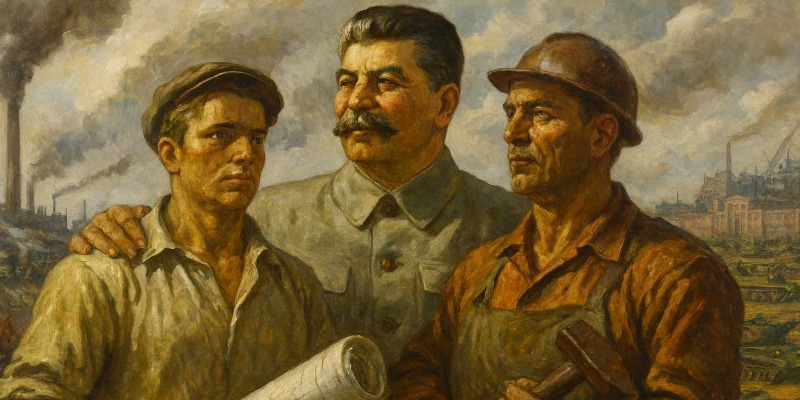
Socialist realism rejected the neutrality of art. Every work had to serve the Revolution, educate the masses, and reinforce the values of socialism. Artists were encouraged (or more accurately, obliged) to portray everyday life through a heroic prism. Workers were depicted as muscular titans, peasants as serene mothers of the fatherland, and soldiers as valiant defenders of the revolution.
There was no room for doubt, tragedy, or moral ambiguity. The universe of socialist realism was Manichean: on one side, the absolute good of the people and the Party; on the other, the darkness of capitalism and its enemies. Any representation of Soviet man had to embody exemplary virtues: honesty, industriousness, loyalty to the Party, self-sacrifice.
Stalin's role in defining official aesthetics
Stalin understood better than anyone how culture could be an instrument of power. In his speeches, he called himself the "gardener of the arts" and personally set the criteria for acceptability for painters, writers, and filmmakers. Stalin's personality cult permeated every aspect of cultural production. His portraits graced paintings, mosaics, theater sets, and films.
The entire creative apparatus was centralized under the control of the Union of Soviet Writers and similar institutions for each artistic discipline. Stylistic deviations, such as expressionism, abstraction, or symbolism, were condemned as "bourgeois formalism" and, in the worst cases, led to the deportation or physical elimination of the artist.
Socialist realism, in Stalin's hands, was not just aesthetics, but the architecture of consensus.
Monumental architecture and the symbolism of power
Architecture also underwent a profound transformation. After a brief flirtation with constructivism, the buildings of the USSR adopted a neoclassical and monumental style. The great railway stations, the Soviet buildings, and the headquarters of the institutions were designed to inspire respect and trust in the regime.
The Moscow Metro became an underground museum of socialist grandeur: crystal chandeliers, precious marble, celebratory frescoes. The architecture was intended to convey order, power, and eternity. Soviet citizens, entering these spaces, were meant to feel part of a superior and immortal civilization.
A landmark project was the never-built “Palace of the Soviets,” which envisioned a 415-meter colossus surmounted by a statue of Lenin: a titanic symbol of socialist power that would have dominated the Moscow skyline.
Literature, cinema and music under surveillance
Literature was among the first fields to be regulated. Writers like Maxim Gorky were placed at the forefront of the ideological line. Novels were expected to follow a linear, moral plot, culminating in the victory of the collective over the individual. Love stories usually ended with a marriage between two young communists and a joyful acceptance of work and communal life.
Cinema, under the leadership of directors like Sergei Eisenstein (who, however, had an ambivalent relationship with power), became a major propaganda weapon. Films were intended to be accessible, didactic, and patriotic. Each film was subjected to strict prior censorship, and directors who dared to deviate from the line risked the gulag.
Music was also regulated. Composers like Shostakovich were first exalted, then condemned as "enemies of the people," and finally rehabilitated. Music had to be tonal, harmonious, easily singable, and possibly inspired by Russian folklore.
Heroes of work and utopian narratives
One of the central archetypes of socialist realism was the "hero of labor." Ideal role models such as Aleksei Stakhanov, the miner who exceeded production quotas, became mythological figures. In schools, factories, and kolkhozes, prizes, competitions, and exhibitions were organized to encourage the imitation of these proletarian "supermen."
The narrative was consistently optimistic, sometimes grotesquely idealized: lush agricultural fields, clean and orderly cities, happy workers at work. The real dystopia of the USSR—famine, repression, poverty—was hidden behind a curtain of fictitious perfection.
The limits imposed on individual creativity
The price of this great feat of cultural engineering was the castration of creativity. Many artists were forced into self-censorship or ambiguous expression to evade controls. Others were forced into internal or external exile, like Boris Pasternak, who managed to publish "Doctor Zhivago" only abroad, at the risk of his life.
Art became predictable, repetitive, and devoid of psychological depth. Official biographies of writers and painters were rewritten to fit the desired narrative. The most daring ended up in the gulag, like Osip Mandelstam, who died in a transit camp for writing non-aligned verse.
The controversial legacy of socialist realism
With Stalin's death in 1953 and the subsequent Khrushchevite "thaw," the USSR slowly began to distance itself from that phase of hyper-cultural control. However, the legacy of socialist realism continued to influence Soviet art for decades.
Even today, this style is viewed ambivalently. On the one hand, it is seen as an instrument of repression and censorship, on the other as a powerful and profoundly defining expression of an era's identity. Some works retain an undeniable aesthetic power, even when created in a context of coercion.
Socialist realism was, ultimately, the most successful (and tragic) synthesis between art and power of the 20th century: an all-encompassing experiment that turned the imagination into an ideological battlefield.
© Reproduction Prohibited