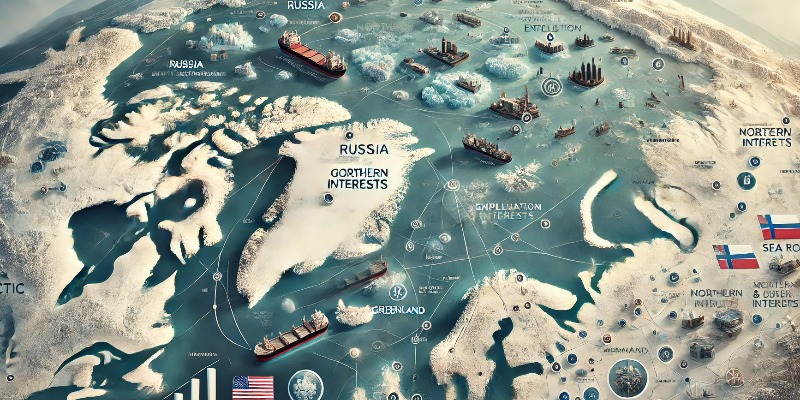
- The Arctic Route as an opportunity and risk of global warming
- Russia's Strategy for Arctic Dominance
- China's goals and ambitions with the Polar Silk Road
- The United States' delay in the Arctic competition
- The importance of natural resources in the Arctic, including oil and gas
- The militarization of the Arctic and the confrontation between the great powers
- The Arctic as a new route for global trade
- The geopolitical and environmental implications of Arctic competition
How Global Warming Is Transforming the Arctic into a Geopolitical Battleground Between Moscow, Beijing, and Washington
By Marco Arezio
Global warming, while threatening the planet, is simultaneously opening unprecedented geopolitical scenarios. The melting of Arctic ice has ignited a competition among the world's major powers—Russia, China, and the United States—for control over new maritime routes, natural resources, and strategic influence. While Russia strengthens its military and commercial presence in the region, China aims to solidify its position with the "Polar Silk Road" project. The United States, albeit belatedly, recognizes the strategic importance of the region and seeks to counter the rise of these other powers.
Russia's Strategy
Russia was the first to seize the opportunities offered by global warming. Shortly after its aggression against Ukraine in 2022, Moscow adopted a "maritime doctrine" that identifies the Arctic as the cornerstone of the Kremlin's geopolitical strategy. The document emphasizes the need to develop a secure Northern Sea Route, navigable year-round, to consolidate Russia's role in global trade.
The militarization of the Arctic, particularly between the Bering Strait and Norway, underscores Russia's ambitions to dominate the region. Russia's icebreaker fleet, the most powerful in the world, is an essential tool for keeping the new northern route open and attracting investment. Furthermore, control over natural resources such as oil and gas further strengthens Moscow's position in the global market.
However, this strategy is not without risks. The growing competition in the Arctic could lead to military tensions with other powers and a regional arms race.
China’s Ambitions
China, although not an Arctic nation, has identified the region as a key to bolstering its global role. With Russia's support, Beijing is promoting the creation of a "Polar Silk Road," an integral part of its broader commercial expansion strategy. This project aims to develop shorter, safer maritime routes that reduce China's dependence on traditional routes controlled by the United States and its allies.
China has also shown interest in Arctic natural resources, such as Russian liquefied natural gas, which is essential for sustaining its economic growth. Beijing views these resources as a strategic component of its energy security and an opportunity to strengthen ties with Moscow.
Despite China's official rhetoric presenting the Arctic as a region for "global cooperation," its actions suggest a more competitive approach. Access to new maritime routes and energy resources bolsters China’s position in the global geopolitical arena.
The United States' Response
The United States, traditionally focused on other parts of the world, realized the strategic importance of the Arctic relatively late. During the Trump administration, interest in Greenland was seen as an attempt to counter Russia and China's growing influence in the region. While initially underestimated, this move highlighted America's increasing awareness of the need for a strategic foothold in the Arctic.
The United States, along with its NATO allies, is working to develop a coordinated strategy to counter Russian and Chinese ambitions. However, the lack of adequate infrastructure and the absence of a competitive icebreaker fleet represent significant challenges for Washington.
America’s position is further complicated by the multilateral nature of Arctic policy, which requires cooperation with other nations and adherence to international regulations. Nonetheless, the growing militarization of the region by Moscow and Beijing may push Washington to strengthen its military presence in the Arctic.
A New Arena for Global Competition
The Arctic is rapidly becoming a battleground for the world's major powers. As global warming accelerates the melting of ice, the commercial and strategic opportunities offered by the region are fueling new geopolitical tensions.
Russia sees the Arctic as an opportunity to strengthen its global influence, while China uses the region as part of its strategy to challenge Western dominance. The United States, though late to the game, is striving to protect its interests and maintain the balance of power in the region.
This Arctic race raises questions about who truly benefits from climate change. While global powers see new opportunities in the melting ice, the ecological and human costs of this crisis risk being ignored. The challenge for the future will be to strike a balance between geopolitical ambitions and the need to protect one of the planet’s most vulnerable ecosystems.
© Reproduction Prohibited