- Origins of Plastic Additives in Virgin Polymers of the Twentieth Century
- Thermal Stabilizers and Antioxidants in the Early Industrialization of Plastics
- Plasticizers, Lubricants and Process Modifiers: Functions and Historical Development
- Standardization of Virgin Polymers and Birth of Formulated Grades
- Industrialization of Additive Manufacturing and Vertical Integration in Petrochemicals
- Evolution of Compounding and Twin-screw Extrusion Technologies
- From the Linear Model to Recycling: First Critical Issues of Traditional Formulations
- Additivation of Industrial Waste: Stabilization and Recovery Strategies
- Managing Post-Consumer Variability: Technical Limitations and Industrial Tradeoffs
- Recycling-Oriented Additives: New Paradigms for the Circular Economy of Plastics
Technical history of plastic additive manufacturing: industrialization, adaptation to recycling, and development of formulations geared toward the circular economy
Technical Manual. Additives and Colorants for Recycled Polymers. Chapter 2: Historical Evolution of Plastic Additives
Birth of additives for virgin polymers
The emergence of additives for virgin polymers coincides with the moment when plastics ceased to be mere chemical curiosities or experimental materials and began to establish themselves as fully-fledged industrial materials. In the early decades of the twentieth century, synthetic resins were used in limited fields and often as cheap substitutes for natural materials, without any real planning for their long-term performance. In this initial phase, the polymer was considered the heart of the material, while any additional substances had a marginal, often empirical, role, linked more to practical experience than to a scientific understanding of chemical-physical interactions.
The first industrial polymers had obvious limitations that hindered their widespread adoption. Many materials were unstable at processing temperatures, degraded rapidly in the presence of oxygen or light, or exhibited a fragility incompatible with industrial use. Processing was often unpredictable, and the quality of the finished product was variable. In this context, the introduction of substances capable of modifying the polymer's behavior became a primary technical necessity. Additives thus emerged as a direct response to concrete processing and durability problems, not as advanced design features.
With the widespread use of thermoplastic polymers after World War II, the role of additives began to consolidate. Materials such as polyethylene, polypropylene, polystyrene, and PVC demonstrated enormous potential, but also structural limitations that prevented their direct use without modification. Their high melting temperatures, sensitivity to oxidation, difficulty in controlling flow, and tendency to thermal degradation during processing made it clear that "pure" polymers were rarely usable under real-world industrial conditions. Additive manufacturing thus became an indispensable component of plastics processing.
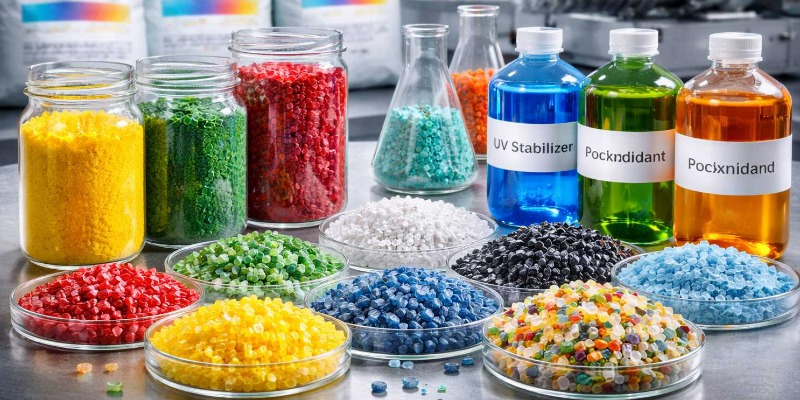
During this historical phase, additives were developed with a highly functional and targeted approach. Thermal stabilizers were introduced to protect the polymer during extrusion and molding; antioxidants to limit oxidative degradation during use; plasticizers to reduce stiffness and improve processability; and lubricants to facilitate material flow through systems. Each additive addressed a specific criticality of the virgin polymer and was selected based on its immediate effectiveness and cost.

A key element characterizing this first phase of additive evolution was the quality and repeatability of the virgin raw material.
The polymers were produced through controlled chemical synthesis processes, ensuring a relatively stable molecular weight distribution and low levels of impurities. This homogeneity allowed the additives' effects to be studied systematically and standardized formulations to be developed, with predictable and reproducible results. The additive could be designed to complement a well-defined matrix, without having to deal with the variability typical of recycled materials.With the progressive consolidation of the plastics industry, additives also assumed a strategic role in technological differentiation. Polymer manufacturers began offering additive-prepared grades for specific applications, while converters developed proprietary formulations to optimize productivity, surface quality, dimensional stability, and mechanical strength. In this context, additives ceased to be perceived as mere correctives and began to be considered an integral part of the material, directly contributing to its final performance.
ADVERTISE YOUR COMPANY ON rMIX MANUALS AND GIVE COPIES TO YOUR CUSTOMERS