




- Van Gogh's arrival in Auvers-sur-Oise: a new hope
- The relationship with Dr. Gachet and the local community
- The creative fury: seventy paintings in seventy days
- Letters to Theo: affection, anxiety and confessions
- The landscapes of Auvers: wheat fields, crows and symbolism
- Vincent's loneliness: restlessness and existential crisis
- The final act: Van Gogh's last days and death
- Van Gogh's Legacy: From Misunderstood to Universal Genius
A journey through the emotions, letters, colors and encounters that marked the epilogue of Vincent van Gogh's life in Auvers-sur-Oise, in the summer of 1890
by Marco Arezio
When Vincent van Gogh arrived in Auvers-sur-Oise, a small village north of Paris, it was May 20, 1890. He was thirty-seven years old, with reddish hair still unkempt and a gaze perpetually hungry for light. His last seventy days were those of a comet burning in its full splendor, leaving an indelible trail in the history of art and the collective imagination. During these ten weeks, Vincent worked tirelessly, almost in a trance, painting more than seventy paintings: landscapes, portraits, still lifes, but above all, his own restlessness and wounded humanity.
This is the story, lived and told day after day, of a man who saw beauty and tragedy in the wheat fields and the troubled skies of Auvers, bringing to completion an existential and artistic parable without equal.
The Journey to Auvers: Hope and Vulnerability
Leaving the psychiatric hospital in Saint-Rémy-de-Provence was both a liberation and a risk for Van Gogh. He wrote to his brother Theo that he felt better, more lucid, but his fragility remained. Paris welcomed him for a few days, a necessary but turbulent stop: the noise, the crowds, and the family tensions made him uneasy.
Theo, his brother-friend, now the father of a child, is concerned about Vincent's mental health and condition, and directs him to Auvers-sur-Oise, a quieter place where Dr. Paul Gachet lives, a doctor passionate about art, close to the Impressionists and willing to follow the tormented Dutch painter.
Van Gogh's arrival in Auvers is marked by a letter to Theo in which he writes:
“I found a magnificent place, with thatched houses, flower gardens, green hills, and Doctor Gachet seems almost sicker than I am, but nice.”
The village, with its cobbled streets, ivy-covered walls, and Gothic churches, seems to offer refuge. But Vincent's tension is constant: moments of great creative energy alternate with days of melancholy, anxiety, and loneliness.
The Creative Fury: 70 Paintings in 70 Days
Never in his life did Vincent paint as much as in the summer of 1890. He went out every day, canvas under his arm, and painted en plein air: the wind-blown fields of wheat, the red poppies standing out against the greenery, the sky with swirling clouds. The brushstrokes became even more impetuous, the colors vibrated with a new, almost feverish intensity.
He paints the gabled roofs of Auvers, portraits of the Ravoux children, and solitary figures along the village streets. One day, in his diary, Dr. Gachet notes:
“Desperate work, every painting seems like a farewell, every landscape is a confession.”
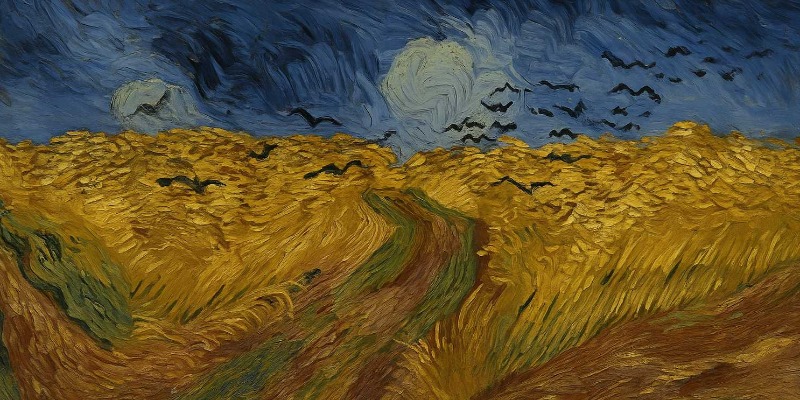
The canvas “Wheat Field with Crows,” one of the last paintings, almost seems like a scream in the storm: the threatening sky, the paths that disappear into infinity, the black birds in flight.
But Van Gogh also paints the serenity of the gardens in bloom and the whiteness of the “Church of Auvers”, as if wanting to find, in the architectural details and colours, a fragile consolation.
The Letters: A Dialogue with Theo and the Family
The days in Auvers were punctuated by constant correspondence with his brother Theo, his sister-in-law Jo, and several friends. In his letters, Vincent poured out his most intimate thoughts: the fear of never recovering, the sense of failure, but also the hope that his works might one day be understood by someone.
Theo remains his support, his emotional and practical point of reference:
“If it weren't for you, I don't know how I could go on…”
But Theo's health deteriorates, work problems and financial difficulties worsen, and Vincent senses the burden he represents on his brother.
This sense of guilt grows day by day, like a cloud obscuring his creativity and transforming his energy into a form of self-destructive urge.The Meetings: Doctor Gachet and the Auvers Community
The relationship with Dr. Gachet is complex and ambiguous. The doctor, who has treated other artists and calls himself a "friend of the Impressionists," understands the depth of Vincent's torment, but often feels helpless in the face of his mood swings.
Gachet himself is a melancholic man, a widower and prone to sadness, and a sort of complicity develops between the two. The doctor poses for Vincent in one of his most famous portraits, painted with rapid brushstrokes and intense colors: a pale face, clasped hands, a gaze that seems to question the future.
In the village, people gaze curiously at the taciturn stranger who tirelessly paints in the fields or pauses to observe a street corner for hours. Some avoid him, others—like the Ravoux family, who hosts him at their inn—learn to appreciate his kind nature, generosity, and almost childlike need for human warmth.
The community of Auvers becomes, in spite of itself, a spectator of the painter's final season, without fully understanding the significance of what is happening.
The Collapse: The Restlessness and the Weight of Invisibility
Despite his creative fury, Vincent's final weeks are marked by a growing sense of precariousness. His letters become rarer and more anguished. He writes to Theo:
“Sometimes I feel like a caged bird… I can’t find my place in the world.”
Tension mounts: nights are haunted by nightmares, sleep is irregular, fears multiply. Vincent feels he hasn't achieved success, fearing that his works will be forgotten or even destroyed.
Social and economic invisibility compound mental illness, leading to a profound sense of isolation.
On July 27, 1890, Vincent left the Ravoux Inn, walked to the wheat fields, and, in a final act, shot himself in the chest with a pistol. Seriously wounded, he managed to walk back to his room, where he spent two days in agony, attended by the Ravoux family and Dr. Gachet.
The last words addressed to Theo are full of resignation and tenderness:
“The sadness will last forever.”
The Legacy of a Bright and Painful Life
On July 29, 1890, Vincent van Gogh died in Auvers-sur-Oise, surrounded by Theo's affection, by a few people who had understood his value, and by a dozen canvases still fresh with paint.
What no one can yet imagine is that those 70 days will become legend: an epic of pain and genius, a testament that suffering can become art, that the line between madness and creativity is subtle but necessary to open new paths for humanity.
Today, retracing every gesture, every brushstroke, every word of his letters, we can see Van Gogh not only as the painter of light, but as the man who knew how to transform the end into a new beginning, giving us a different view of the world.
Conclusion: A Man Between the Ears of Corn and the Sky
Vincent van Gogh's Last 70 Days is a universal tale of hope, struggle, and beauty, of vulnerability and the search for meaning. In every painting from that summer, there's a desire to say, once again, that life—even in its darkest recesses—can find the strength to illuminate the future.
And so, in Auvers, among the golden ears of corn and stormy skies, the genius of Vincent van Gogh continues to speak, to move and to inspire anyone who still feels the need to look beyond the visible.
© Reproduction Prohibited