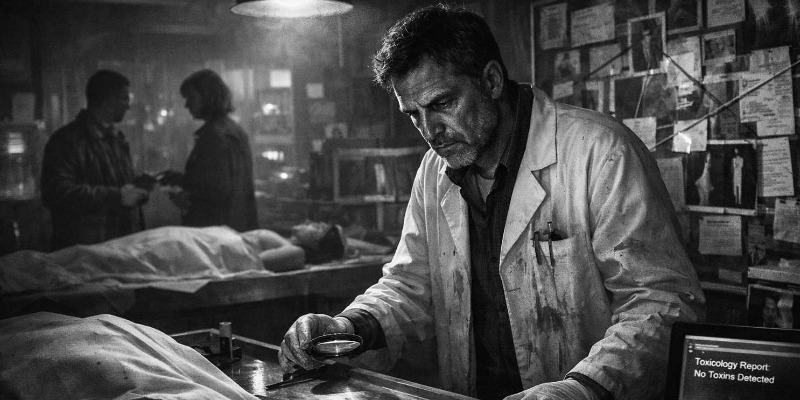
Andrea Riva, a medical examiner at Bellano Hospital, finds himself facing a case that challenges all his certainties. Two mysterious deaths, two autopsies with no answers. No organ damage, no trace of poison or toxic substances: a void that seems to scream at anyone trying to make sense of that absence.
But while the university clinic's report casts more shadow than light, the investigation becomes intertwined with the fates of those close to him. The deaths are not random, and whoever is behind these murders seems to know how to eliminate every piece of evidence. Andrea and the team find themselves hunting an invisible killer, where every clue could be a trap and every move a step closer to the precipice. A web of secrets, a cryptic message that emerges only in the details, and a race against time that strikes fear into the heart of Bellano.
An investigation that defies logic, with unanswered autopsies, unsolved murders, and secrets hidden in the heart of a small town
Mystery Novel. The Secrets of Piona Abbey. Chapter 13: Death Without a Trace. The Mystery Surrounding Bellano
Andrea started work at 8:15 a.m. at Bellano hospital with the feeling that a day that wouldn't stay within the confines of routine. He'd left Lisa at home while he got ready for school: she was bustling around in the kitchen, her bag already packed, her hair hastily tied, a concentrated air that wasn't just that of a teacher. Andrea had greeted her with a quick kiss and a "See you later," but that "later" had a different flavor, as if they both knew that certain investigations never stay outside the front door.
At 8:30 a.m., the department meeting began. Sitting around the table: two doctors, a resident, and the head nurse with her clipboard and that ability to spot problems before anyone else. A quick update, exchange of information, triage of priorities. Nothing explosive: an elderly patient with stabilizing heart failure, a calm post-op, a couple of discharges expected.
“Any critical issues?” asked the older colleague, almost as if to ward off superstition.
The head nurse shook her head. "Not yet. If nothing changes today, it should be fine."
Andrea merely nodded. He was used to that vocabulary: for now, it should, if it doesn't change. Hospital work is a chess game with the unexpected.
After about twenty minutes, everyone took their turn. Andrea returned to his office, closed the door behind him, and took a breath. Then he saw her.
On the desk, placed with almost formal care, was a yellow envelope bearing the letterhead of the university clinic that had entrusted the analysis of the findings from the two bodies he had performed the autopsies on. His name was printed in block letters. The postmark was recent.
Andrea stood still for a second. That envelope wasn't just a piece of paper: it was an important answer to a complex mystery. And in those cases, the answers are sometimes scarier than the questions.
He sat down, slipped a finger under the flap, and opened it. Inside was a small, stapled folder. He pulled it out, placed it on the table, and read the header.
COMO UNIVERSITY CLINIC – DEPARTMENT OF FORENSIC MEDICINE AND FORENSIC TOXICOLOGY
HISTOPATHOLOGICAL AND TOXICOLOGICAL REPORTS – ORGAN SAMPLES
Protocol no. CU-MLT/27-K38983691
Reporting date: February 25, 1960
Applicant: Dr. Andrea Riva – Bellano Hospital
Subject: Additional investigations on organ samples (liver and heart) relating to two subjects undergoing forensic autopsy.
1) SUBJECT A – SAMPLES: LIVER / HEART
Material received:
Liver parenchyma fragments, fixed in 10% buffered formalin, embedded in paraffin (3 cassettes).
Left ventricular myocardial fragments and interventricular septum, fixed and included (3 cassettes).
Aliquots for chemical-toxicological analysis (storage at -20°C): liver (50 g), peripheral blood, urine (if available according to the transmission report).
Histological examination (H&E; special stains if indicated):
Liver: Lobular architecture substantially preserved. Moderate focal microvesicular steatosis (<5% hepatocytes). Absence of bridging necrosis, absence of significant inflammatory infiltrate, absence of canalicular cholestasis. Portal spaces free of significant fibrosis (stage F0–F1 according to semiquantitative criteria). No evidence of Mallory-Denk bodies.

Heart (myocardium): Myocardium with regular-caliber fibers, without areas of recent coagulative necrosis.
Absence of interstitial inflammatory infiltrate consistent with myocarditis. No evidence of significant interstitial edema. Moderate focal interstitial fibrosis consistent with nonspecific age/stress-related changes, not conclusive. Coronary arteries cannot be assessed on parenchymal samples (refer to the macroscopic autopsy report for coronary circulation status).Forensic toxicological analysis (screening + confirmation):
Method: Immunochemical screening of blood/urine where available; GC-MS and LC-MS/MS of liver and blood extracts; detection of volatiles and solvents; panel of drugs of abuse and common drugs (benzodiazepines, opiates, tricyclic antidepressants, SSRIs, antipsychotics, beta-blockers, calcium channel blockers), organophosphate/carbamate pesticides, heavy metals (ICP-MS screen where indicated).