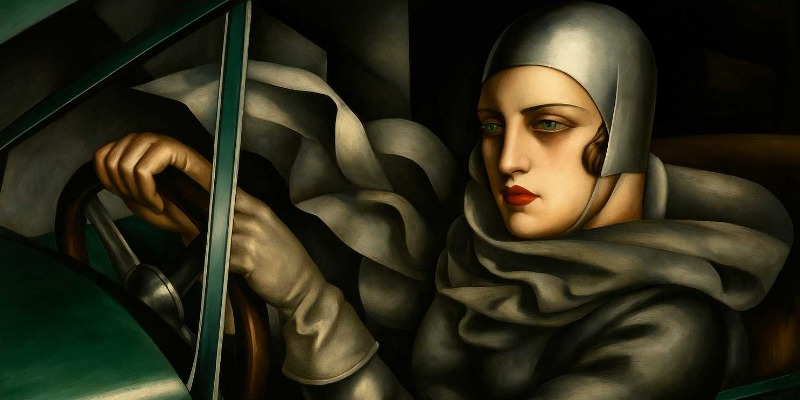
September 1960. Como was living days suspended between the lightness of summer and the shadow of approaching autumn: the lake shimmered under a slanting light, Swiss tourists were returning from across the border, and the air smelled of roasted chestnuts and freshly ground coffee. In the bars, people were enthusiastically discussing the major twentieth-century exhibition at the Civic Museum, where Italian and European works traced a path of modernity. At the center of it all was a rare and precious loan: Tamara de Lempicka's famous painting, "Woman in a Green Bugatti."
The city proudly observed this cultural season, with students, families, and curious onlookers flocking to see a work already considered an icon of style and modernity. The news celebrated the event, shop windows displayed petrol-colored posters, and Como rediscovered itself as an artistic hub. But right in the heart of that vibrant normality, something was about to crack.
As the waiters' voices intertwined with those of the returning commuters, and the plane trees dropped their first leaves on the sidewalks, a silent absence prepared to shake the city. In a few hours, Como would see its balance between elegance and routine shatter, transforming into the theater of an unexpected mystery, destined to unfold like the silhouette of a green Bugatti on a canvas.
A taut thriller set in 1960s Lombardy: Commissioner Marini’s investigation into the theft of the famous Tamara de Lempicka painting
Stories. The Painting of the Woman on the Bugatti: Lucia Marini’s Investigations and the Mystery of the Missing Painting. Chapter 1
September in Como had its own light: no longer the full embrace of July, not yet the thin blade of October. It was an oblique light that slid over the slate roofs and shattered into splinters on the lake, like glass that stubbornly refuses to go dull. On September 10, 1960, the boats were still making their trips between Bellagio and Cernobbio, with those wooden benches that creaked softly, and a trail of foam that looked like white handwriting. Swiss tourists were beginning to head back across the border, soft suitcases and light suits, last-minute postcards with a picture of the Cathedral; the more cautious had already put their sandals away, the others dared the breeze with a sweater over their shoulders.
In Piazza Cavour the waiters shone their trays in the sun, careful not to lose the echo of foreign voices that still filled the small tables: a German explaining the way to Dongo, a couple from Milan talking about a new refrigerator they’d seen in a shop window, two students from Volta arguing spiritedly about a painting “strange, but modern” they’d seen at the museum. In the alleys that rise from the lake toward the city, the smell of roasted chestnuts mixed with that of coffee roasted in bars with wooden counters and chrome machines, and now and then a window opened onto a kitchen where Sunday sauce was simmering ahead of time, amid wooden ladles and radios turned on.
The streets returned a little music: the light hum of Lambrettas, the decisive step of those returning to the office after a break, the bell of a bicycle asking for way. In the shop windows, the first thin-wool jackets peeked out among the white shirts, and in the haberdasheries the clerks folded petrol-colored scarves, one of the season’s “new” colors. Along the lakeside, the plane trees began to shed leaves as big as hands, which fell slowly and stuck to the damp sidewalks of dawn; children jumped on them to hear the crackle, dragging their shiny leather satchels behind them.
Further on, toward San Giovanni station, the metallic breath of the trains could be heard: departures announced in a firm voice, arrivals that returned embraces and parcels wrapped in paper and string. Someone came for work from Brianza, with fingernails still marked by sawdust; another came down from Milan with a newspaper under his arm, talking about a film seen at the Astra cinema and a center-forward who, they say, will shine this year. The shop shutters slid noisily, and behind the glass the September displays were being prepared: polished shoes, soft hats, green-covered notebooks for those going back to school.
On the piers, sailors tied the mooring ropes with slow gestures, repeated a thousand times, and the water gave off a clean smell, a little iron, a little seaweed. Ladies at aperitif hour picked shaded tables to avoid the “staining oblique sun,” and ordered a light white with two olives; men talked business, suppliers, a new client in Chiasso. The city breathed slowly, as after a not-too-long run, letting warm air come in and out of the half-closed shutters.
Yet beneath that elegant calm there was a subtle vibration that only certain late-season days know how to give: as if everything were about to change tone, to lower by half a degree. The lake glittered — yes — but already at a certain hour a coolness came that suggested a shawl over the shoulders or the first jacket pulled out of the wardrobe. On the benches the elders spoke of the upcoming grape harvest and the chestnuts that “this year will come out well”; the young men, sleeves rolled to the elbows, counted the Sundays left before school, trying out guitar chords that frayed in the wind.
In the bars, between a game of briscola and the clink of teaspoons against glass, people discussed the Modern Art exhibition: “Did you see that woman at the wheel, with the green car? They say she comes from Lugano, a big loan.” The name de Lempicka rolled off tongues like a foreign word with a beautiful sound, repeated for the sheer pleasure of pronouncing it well. There was a tangible pride in the air — the pride of a city that knows how to present itself — and a clean, almost childlike curiosity for that glossy image that smelled of modernity: the road, the engine, the resolve in the glance.
At Ponte Chiasso the border did its job as always: looks, stamps, tarpaulins to lift, questions repeated. The resort season faded, and in their place returned the trucks of textiles, the crates from factories, the commuters’ suitcases with cheese wrapped in oiled paper. It was that quiet, well-oiled normality that held the city together: the discipline of those who know their schedules, the gruff kindness of the workers, the strong hands of those who load and unload without making noise.
Nothing, that morning, betrayed the idea that an invisible wound was about to open. Clouds raced high and intangible, newspapers waved headlines with news from Rome and the world, the lake continued to return reflections as if nothing could disturb it. And it is precisely in that instant of trust — when the day slides along familiar tracks and the city feels safe in its routine — that the unexpected happens.
Of the Civic Museum — a harmonious hybrid between a nineteenth-century palace and postwar municipal rationality — the people of Como knew every step. The sober façade, the cobbled courtyard with its central plane tree, the tall entrance hall where echo turned footsteps into small thunders. The Early Twentieth-Century room was the beating heart of the temporary exhibition: a luminous rectangle with hemp-colored walls chosen so as not to distort tones, parquet polished with wax that creaked only slightly, and aluminum light rails — very modern for the time — which distributed measured, never harsh, illumination. On the pedestals, ivory cardboard labels with a dry, philological typeface; on the entrance panels, the title in black: “Speed, Line, Modernity: Art 1909–1939.” The curatorial signature, Dr. Elisabetta Piani, already suggested rigor.
Inside, the “Woman on the Green Bugatti” had been placed as a scenographic pivot: on a facing wall, at 140 centimeters from the floor, slightly off-center from the room’s axis to surprise with its impact. It was a private loan spoken of in hushed tones with a mix of pride and apprehension: a Swiss industrialist from Lugano, known among dealers as reserved and fussy, had agreed to lend the work for six weeks, on condition of an international insurance policy, thermohygrometric control within strict parameters, and constant surveillance — concepts that in 1960 sounded almost exotic. The crate, arriving with numbered seals and a courier who never let go, had been opened in an inner room: cotton gloves, a magnifying glass, Japanese tissue to protect the corners. Even a luxmeter had appeared, a rare instrument, to measure incident light.
Around it — the Lempicka shiny as chrome, the green cut by arrows of chiaroscuro — the exhibition unfolded in crescendo: at the start a small Balla, splinters of light escaping the frame; a little further on a Boccioni on paper, a body in dynamic tension; Sironi with a severe periphery, dense as a winter morning; a Carrà with a more lyrical tone, softened cubism; Severini dancing among patterns and perspectives; a de Chirico with a metaphysical square, clocks stopped and statues listening. A side room introduced the postwar: a Fontana with a split darkness, an Afro nebulous, a nervous Vedova, like a restrained roar. There were also authorized reproductions of Léger and a small Klee on loan from Basel, little precious European breaths. The Lempicka, however, split the visual corridor: the eye reached it as if drawn by a magnet. A screen-printed poster placed outside — Bugatti profile and sans-serif, petrol green — had plastered the town: shop windows, bars, tram stops. Students from Volta and Ciceri arranged to meet there, the ladies with hats spoke of “American charm,” and engineers from the Textile Mill discussed aerodynamics in front of the painting as if it were a hood to be opened.
The clamour had been swift: articles in the Corriere, a radio column on Sunday morning, even a piece in the Lugano press praising the “transfrontier cultural courtesy.” The catalogue — dark green cover, coarse paper, trichrome photos — sold out in a week. In the entrance display case, alongside loans insured by Italian museums, stood out the two private loans: besides the Lempicka, a small Morandi owned by a Milanese collector, bottles standing like silence. The room had been organized with velvet ropes at a safe distance, two guards at peak days, an electric clock that staggered the visits. And yet, in the almost domestic routine of a civic museum, security remained that of an era when respect — more than technologies — kept risks in check: good locks, watchful eyes, no alarms except the custodians’ “moral” one.
That is why, when at the hour change Barzaghi looked up and saw the two naked hooks swinging faintly, the absence sounded deafening. In the clearest rectangle — left by the dust raised and a slanting sun that had “tanned” the wall around it — the memory of the painting read like a photographic negative. No broken glass — the Lempicka was not behind glass, because “art must breathe,” someone would say — no pried thresholds, no ransacked corridor: only a blue blanket carelessly folded on a distant chair, which did not belong to the museum’s furnishings, and that stub of a Gauloises with a fingernail of lipstick that betrayed the flatness of an ordinary afternoon.
Dr. Piani arrived out of breath from the cataloguing room, the 2H pencil still tucked behind her ear. She stopped a few steps away, as if before an archaeological void. She had wanted that exhibition: months of letters in French, phone calls across the border, notarial signatures, humidity conditions noted in the margins, polite quarrels about lumens. She had discussed the sequence late into the night: first the Futurist shock, then the metaphysical breath, then modernity as object — machine, road, bodywork. At the center, Tamara, because it was not just style: it was icon. A woman who drives, who looks, who decides. They had wanted it there precisely for that phrase — “decides” — which in the loan paperwork appeared as a poetic aside out of place, and instead was the reason for everything.
Staff rushed in, a guide tried to calm an overly curious class. From the courtyard, where one always smells a little of rain even when it doesn’t rain, came the voice of a chestnut vendor. The city flowed on unaware, and yet, within those four walls, something irreparable had just occurred.
The frames of the other paintings seemed to look at that void as if they understood. Balla vibrated faster, Sironi became more severe, de Chirico sighed a little longer. The Bugatti was gone, and the visual pivot that held together the exhibition had unscrewed in one gesture.In the office room, the phone began to ring like a gentle siren: the Municipality, local press, a journalist from Milan, and — above all — the border station at Ponte Chiasso. In a few words, the real world re-entered with the force of a wide-open door: a Swiss loan to protect, a border a few kilometres away, international collecting at large. The policy demanded to be honoured, the city to be compensated, Europe not to lose a piece of itself on some random quay.
And in that instant, as if the room itself had taken a breath and then returned it, everything thought out to display became a pretext to investigate: the hanging notch noted in the restorer’s notebook, the weave of the packing blanket fabric, the wing-nut left loose behind a nearby frame, the cone of plaster dust fallen beneath the hooks. Minimal traces, invisible to most, but not to those who know that museums, more than banks, record every gesture: a choreography of hands that install, adjust, clean. From that alphabet of tiny things — wax, plaster, velvet, Japanese paper, blue cloth — the hunt would start.
Thus the room reserved for early twentieth-century masterpieces, born to celebrate speed and line, became a crime scene: a silent theatre in which the leading actress was missing and only the sign of her absence and the echo of the hubbub that, an hour earlier, had streamed lines at the entrance, catalogues under arms and satisfied whispers, remained. From there, from the luminous void at the centre of the wall, began the story that would overturn Como’s air, pushing it — suddenly — toward border roads, Cantù carpentry shops, Sesto warehouses, depots at Linate and back. But everything really began there: between bare hooks, a shadow of dust, no broken glass and the nervous signature of a mind that had planned the theft “with maniacal care.”
Captain De Sanctis of the Guardia di Finanza had the short, economical step of someone used to counting meters between one barrier and the next at the border. The Ponte Chiasso checkpoint buzzed with small noises: stamps pounding on bills of lading, the dry metal of gates rising, truck tarpaulins torn down, the smell of diesel and wet rope clinging to clothes. On the lintel of the customs hangar, neon lamps returned a greenish light, while the finance officers in green-gray uniforms noted down plates, weights, origins in cardboard ledgers.
When the call came from the Civic Museum of Como — a broken voice, words stumbling into the void of a wall — De Sanctis did not lose a second. He shut himself in his dark-wood office, a poor and tidy room: a road map pinned with two tacks, an Olivetti Lettera 22 typewriter with a freshly changed ribbon, the worn border manual on the shelf. He took the receiver and dialed Commissioner Lucia Marini’s private number. He introduced himself with the calm one uses in grave moments.
“Commissioner, this is De Sanctis, Guardia di Finanza, Ponte Chiasso. Forgive my frankness: we have a missing painting. Tamara de Lempicka, Woman on the Green Bugatti. Direct report from the museum. We fear an imminent attempt to export it.”
A pause, the rustle of papers on the other end. Lucia Marini’s voice, steady and low: “Since when? Who has been notified? Which gates are you holding?”
“The museum speaks of a gap between 4:00 and 5:00 p.m. We’ve already raised controls on tarpaulin vans, furniture crates, double bottoms. I have men at the freight barrier, in the yards and in the customs warehouse. But if the canvas is already on the move, we have a narrow window. Milan is the bottleneck. I need you.”
A silence of decision, not hesitation. “I’m at the Police Headquarters in Milan,” Lucia said. “I’m leaving immediately. An hour and thirty if traffic holds. Keep ready to block any suspicious exit at Chiasso. Meanwhile, log every bill of lading bound for Linate with destinations Paris, Zurich, Basel, New York. Call me by radio every thirty minutes with updates. I’m coming with the team.”
“Received, Commissioner. I won’t let a single easel pass without looking it in the face.”
He hung up. He stepped out into the hubbub of the hangar and raised his voice just enough: “From 3:30 p.m. onward we conduct thorough inspections of all tarpaulin trucks. Pay attention to poster tubes, curtain rods, plywood chests. I want tapping surveys on panels and double bottoms. Whoever has gloves, put them on; whoever has doubts, turn them into certainties.”
In Milan, the Police Headquarters on Via Fatebenefratelli smelled of paper, smoke and old wood. Lucia Marini closed three minor robbery files, slipped on a sand-coloured trench coat, took her bag with the Beretta 7.65, a torch and two squared notebooks. Waiting for her in the courtyard was the Questura’s FIAT 1100, dark, its paint slightly matte and an auxiliary headlight fixed in front of the grille. On the hood you could barely read the reflection of a sky already fading.
“Get in,” she said. With her climbed her people:
Carlo Bruni, inspector, blue jacket with shiny elbows, notebook in the inside pocket, a hawk’s eye for detail. He knew how to use silence like a blade.
Teresa Galli, hair tied up, cotton gloves half on, a memory that photographed chassis numbers, crate dimensions, seals.
Beppe Conti, driver and mastiff, big hands, cigarette stub at the corner of his mouth: with the 1100 he pulled off things that looked like tricks, but were only wrist and an ear for the engine.
Beppe turned the key. The four-cylinder came to life with a tight rumble. The long gear lever described a decisive arc, engaged first. “Boss, we’ll do the Milano–Laghi and then up to Como. If the road’s clear, we’ll be at Lainate in a flash.”
“No flash, Beppe: precision,” Lucia cut in. “Carlo, call Operations Center: I want a note to all patrols heading out on Lainate, Saronno, Lomazzo. Teresa, take a sheet: list the likely exit routes and types of packaging. They’ll use furniture covers or car upholstery. I’d bet my wages on it.”
The 1100 slipped between the trams of Via Manin and the slow taxis of Palestro, threaded Corso Sempione, then the Milano–Laghi. The flattened light of late afternoon made the continuous stripe glitter. Beppe kept a steady 90 km/h, left hand on the wide wheel, right ready on the lever.
At the Lainate tollbooth the attendant leaned out: “Questura? Go on through!” The barrier rose with provoked slowness. Beppe watched it until the last centimeter and then pressed down. Air entered through the deflectors, bringing the smell of fields and green petrol.
“Carlo, status?” Lucia asked without turning.
“Operations has put Sesto San Giovanni and Bresso warehouses on alert: many ‘Cantù furniture’ crates in transit this afternoon. I requested a cross-check with shipping documents toward Linate. A Galleria Orione asked for a loan of Art Deco works yesterday, but they have no right to withdraw anything. Smells bad.”
Teresa looked up from the pad: “List of probable hiding places: double bottom in a crate 140×100, poster tubes, masonite panels inserted in the hoods of cars in production, wardrobe bottoms.”
Lucia nodded. “Good. Beppe, watch for tow trucks and OM little lions: if you see low tarpaulins with new straps, memorise. Carlo, note plates we pass; Teresa, call Ponte Chiasso every thirty minutes. If they notice abnormal weights for the same volume, stop and open.”
The motorway curved gently after Saronno, then the scenery turned into a slight plain, low warehouses and rows of poplars. Wind pushed scraps of paper along the roadside. Each overpass rumbled on the roof of the 1100 like a drumbeat. Beppe shifted into third for a climb, then back into fourth: “Holding, holding. But if we get rain before Grandate, I’ll slow down. These soaked tyres dance.”
The radio crackled: De Sanctis live from the border. “Commissioner, update: stopped a sand-coloured 1100 van with two men. Bill for ‘upholstery components’. We’re conducting a thorough search now.”
Lucia leaned forward just slightly, as if to shorten the physical distance to the receiver. “Good work, Captain.”
The line fell silent. The FIAT kept eating kilometres. To the right enamel signs slid by: Lomazzo, Fino Mornasco, then the valley throat opened. The lake was not yet visible, but the light changed: a colder, almost metallic reflection.
Beppe slowed: “We’ll enter Como Sud in five. Then we skirt and go straight up to the Civic?”
“No. First Ponte Chiasso,” Lucia replied. “I want to see tarpaulins and crates with my own eyes. Carlo, prepare forms for every suspicious vehicle we find. Teresa, get a magnifying glass and a pair of tweezers: if I find wax or plaster, I want them in a bag within thirty seconds.”
The 1100 took the Grandate exit with a jolt. Beppe pressed, the siren let out a short, disciplined cry; two Topolinos pulled aside like startled hens. The front seat trembled under the push, the thin wheel vibrated in the driver’s hands; the Veglia speedometer rose, paused a moment, then obediently fell back with a nod from Beppe.
Inside the cabin, no one spoke just to fill the silence. Everyone knew every minute was a piece of canvas moving away. Lucia kept her gaze fixed beyond the windshield, as if she could focus the museum room’s empty rectangle and fill it with the force of will alone. Her hands, however, remained steady on the papers.
When the white and red barrier of Ponte Chiasso appeared, the sky had taken on the colour of steel. The plane trees waved wide leaves like hands, the men in green-gray turned at the siren’s sound. De Sanctis awaited them in the centre of the square, hat in hand, face taut and shiny. Behind him, the trucks in line looked like nervous horses at the start.
Lucia got out of the 1100 without losing her stride. “Captain, let’s inventory the exits, then we’ll touch every hood, beat every panel. Not a minute to waste.”
© Reproduction prohibited