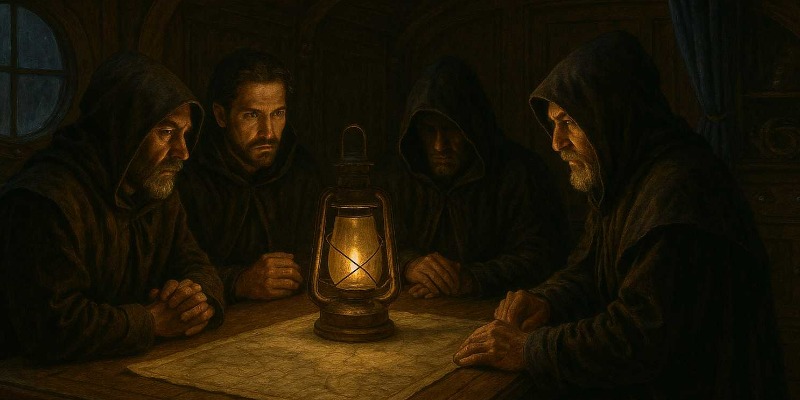
In a torrid summer of 1381, Kent sees the birth of an unexpected voice among the ears of corn and sweat: that of John Ball. The preacher, barefoot and grey-haired, speaks to the peasants of a God who recognizes neither masters nor corvée. His homilies, repeated in markets and taverns, bounce like sparks on the dry hay of fiscal injustice.
From the imposing Canterbury Cathedral, Archbishop Simon Sudbury smells the fire and entrusts the case to the stern Brother Elara. Armed with inquisitorial bulls, the friar sets out along the Pilgrim's Road, determined to chain the word that destabilizes the kingdom.
Along the way he encounters tents of rioters, tax books thick with rage, and monks torn between obedience and compassion. Ball, meanwhile, continues to move from abbey to abbey, weaving with his questions the plot of a collective dream. As the hunt tightens, subtle betrayals and ciphered letters trace an inevitable path to the chapter house of St Albans.
There, in a courtroom filled with incense and suspended glances, jurists and theologians begin a trial that looks more like a duel of consciences. Between imminent capture, internal doubts and popular tensions, the story lets the central question vibrate: can the truth survive the law?
From an incendiary sermon in the Medway stubble to a trial for heresy in St Albans: the story of John Ball, a preacher of social equality who defied nobility, clergy and crown
The summer of 1381 warmed Kent beneath a pale yet stubborn sun. In the Medway valley, the stubble crackled under the dusty sandals of an elderly preacher whose rough tunic was cinched at the waist with a rope. That day John Ball hungered not for bread but for ears to hear him.
He walked among the sheaves like a bishop pacing the nave, bending to brush the soil, lifting a clod he showed to the bent-backed mothers harvesting:
“Do you see, sisters?” he asked in a hoarse, deliberate voice that reached everyone. “This earth belongs neither to earl nor king. It is dust, as we are dust. And if the earth is everyone’s, whose should its fruit be?”
A woman, her brow shiny with sweat, dared reply:
“Father Ball, the bailiff will say the fruit is the lord’s, for we owe him corvée.”
“And what will you answer?”
“That the corvée is heavier than the plough, that the tithes drain the milk from our children … But who will heed our lament?”
John Ball stretched his arms wide, as if to embrace the whole golden plain:
“Christ will listen—He was a carpenter. And you will listen to yourselves, for the Spirit moves first in the breast of those who suffer.”
Such words, repeated in taverns at night, made mouths vibrate like hunting horns. For weeks publicans had tallied one less ale sold and one more murmur hidden among the benches; and that murmur always beat the same two-step rhythm, as though it marched on feet of its own: e-qual-i-ty, e-qual-i-ty.
Meanwhile in Canterbury, light filtered through the stained glass of the chapter-house, sketching shifting stripes across the wooden backs of a round table. Simon Sudbury, Archbishop and Lord Chancellor of the Realm, pressed a lead seal onto parchment still warm with wax.
“Brother Elara, have you read the text carefully?”
“Three times, Your Grace. Ad abolendam prescribes severity toward heretics, especially the relapsed.”
“Are you not troubled that this man, excommunicated many times, continues to speak to the crowds like a new Peter?”
“It troubles me that he does so in English, my lord. The common folk understand, and when they understand, they fancy they have a voice.”
Sudbury traced the sign of the cross upon the page:
“Take these inquisitorial powers. I grant you authority to gather testimony, convene synods, confiscate writings, and, if need be, degrade the cleric and deliver him to the secular arm.”
Elara bowed his head, yet inside he felt an ambiguous stirring: the zeal of faith and the echo of a tender remorse. He was the son of a cloth merchant; he knew hardship, the sharp tongue of tax collectors, the bite of a levy arriving when the coffer is empty. Even so, he had embraced God, convinced truth needed a wall lest it yield to the winds of demagoguery.

© Reproduction prohibited