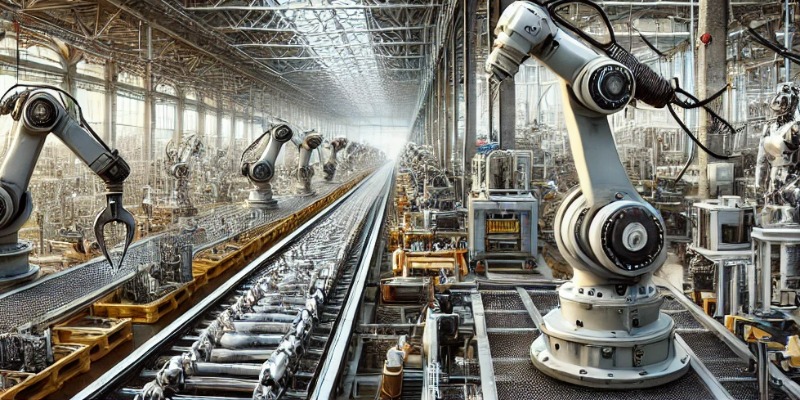







- The Future of Manufacturing: Automation and Job Loss
- Autonomous Vehicles and Transportation: How AI Will Revolutionize Mobility
- Automation in the Financial Sector: Between Risks and New Opportunities
- The Impact of Legaltech on Legal Professionals
- Retail in the Age of Automation: Salespeople and Robotics
- Healthcare and Artificial Intelligence: How Roles in the Healthcare Sector Are Changing
- Skills Needed in the Future: Reskilling and New Professions
- The Challenge of AI: How to Address the Transition to Automation in Different Sectors
In recent years, the advancement of artificial intelligence (AI) has opened scenarios of profound change in the world of work, raising concerns about the potential impact on jobs
by Marco Arezio
While many industries will benefit from automation and artificial intelligence, others risk experiencing a drastic reduction in personnel, with significant social and economic consequences.
According to estimates and projections from numerous studies, the next 20 years could see a substantial transformation of the job market, with some professional categories particularly exposed to the risk of replacement by machines and automated systems.
Manufacturing and Production Sector
The manufacturing sector is likely to experience the greatest impact from automation and artificial intelligence.
Industrial robotics are already widely used in many facilities today, and as technology advances, more and more production processes may be automated.
A report by the McKinsey Global Institute estimates that about 60% of all tasks performed in factories could be automated by 2040.
This means that operations like assembly, welding, and material handling could be performed by robots more efficiently and at lower costs than human labor.
This could result in a net loss of millions of jobs worldwide. However, the industry itself may see an increase in demand for professionals with specialized skills, such as robotics engineers, maintenance technicians, and software developers for industrial machines. The main challenge will therefore be retraining workers for more technical roles.
Employment outlook:
Jobs at risk: skilled and unskilled laborers, assembly line workers, quality control operators.
Jobs in demand: specialized technicians, mechanical engineers, software developers for robotics.
Transportation Sector
Automation in the transportation sector has been one of the most discussed frontiers in recent years, especially with the advent of autonomous vehicles.
According to a study by the World Economic Forum, 57% of transportation-related jobs could be at risk by 2040. Truck drivers, bus drivers, taxi drivers, and logistics workers are particularly exposed.
The adoption of autonomous vehicles is expected primarily in freight transport and urban deliveries. Road transportation could be radically transformed, with self-driving trucks covering long distances without needing breaks, improving efficiency but reducing the need for drivers.
At the same time, drone and robot technologies for last-mile deliveries threaten the jobs of those involved in home deliveries and city logistics.
Employment outlook:
Jobs at risk: truck drivers, taxi drivers, delivery workers.
Jobs in demand: autonomous vehicle maintenance experts, traffic data analysts, advanced logistics specialists.
Financial Sector
Technologies based on artificial intelligence are radically changing the financial sector. From automating back-office processes to algorithmic trading platforms, AI is capable of replacing many functions previously performed by humans.
According to a PwC study, it is estimated that 30% of jobs in the banking and financial sector could be at risk over the next two decades.
The rise of robo-advisory platforms, capable of providing automated financial advice, could reduce the need for traditional financial advisors.
Jobs such as financial data analysts, insurance agents, and brokers may also see a sharp decline in demand.
However, AI will also create new opportunities for roles related to big data analysis, cybersecurity, and the development of new financial technologies (fintech). The digitalization of the sector will increasingly require specialized skills in these areas.
Employment outlook:
Jobs at risk: traditional financial advisors, insurance agents, financial analysts.
Jobs in demand: cybersecurity experts, data scientists, fintech developers.
Legal Services Sector
The legal sector, historically resistant to automation, is gradually seeing the introduction of advanced software capable of analyzing contracts, gathering evidence, and even making legal decisions in routine cases.
This phenomenon, known as "legaltech", threatens a large portion of the tasks performed by legal assistants and junior lawyers.
According to Deloitte research, 39% of legal jobs could be automated in the next two decades.
AI is already able to conduct legal research, analyze legal documents, and offer solutions for minor legal disputes.
However, more strategic and complex roles that require a high level of judgment and creativity will remain the domain of humans. The demand for legal specialists in technology and cybersecurity, meanwhile, is expected to grow.
Employment outlook:
Jobs at risk: legal assistants, junior lawyers, legal operators in standardized sectors.
Jobs in demand: legal cybersecurity specialists, technology legal consultants.
Retail Sector
Automation in the retail sector, through the introduction of self-checkout systems, customer service chatbots, and intelligent e-commerce platforms, is already radically transforming the way consumers interact with sellers.
A study by the Oxford Martin School predicts that 45% of jobs in the retail sector could be at risk by 2040, especially in physical stores.
The rise of automated, staff-free stores, such as Amazon Go, is an example of the potential of automation in this sector.
Even the warehouses of large e-commerce platforms are increasingly replacing human workers with intelligent robots for inventory management and order preparation.
Employment outlook:
Jobs at risk: cashiers, sales assistants, warehouse operators.
Jobs in demand: e-commerce management experts, robotics maintenance technicians for logistics, digital marketing specialists.
Healthcare Sector
Although the healthcare sector seems less exposed to automation than others, there are still areas where artificial intelligence could reduce the need for human workers.
For example, the use of robots to perform precision surgeries or automated diagnostics through machine learning algorithms could decrease the demand for some healthcare professions.
However, it is important to note that the healthcare sector will see strong growth in demand for workers with technical skills and direct patient care roles, with an expansion of positions related to telemedicine, health data management, and home care.
Employment outlook:
Jobs at risk: laboratory technicians, healthcare assistants in more repetitive tasks.
Jobs in demand: telemedicine specialists, data analysts for health data, specialized nurses and healthcare personnel.
Conclusions
The impact of artificial intelligence on the world of work over the next 20 years will be vast and varied, with traditionally labor-intensive sectors seeing a significant reduction in human labor.
However, automation and artificial intelligence will not completely eliminate jobs but rather shift demand toward new skills.
The challenge for governments and businesses will be managing this transition, investing in professional retraining programs, and adopting policies that support the creation of new jobs in emerging sectors.
The ability to adapt will be crucial to ensuring that technological progress benefits everyone, without excluding significant portions of the workforce.
© Reproduction prohibited