- Introduction to Smart Concretes
- Photoluminescent: Eco-Sustainable Lighting
- Smog Eater: Concrete that Purifies the Air
- Self-repairing: The Future of Infrastructure
- Draining: Efficient Water Management
- Living Concrete: Biologically Active Materials
- Space Concrete: Innovations for Extraterrestrial Exploration
- Conclusion: The Future of Sustainable Construction
Discover How Six Innovations in Concrete Are Transforming Construction, Enhancing Performance, and Reducing Environmental Impact
by Marco Arezio
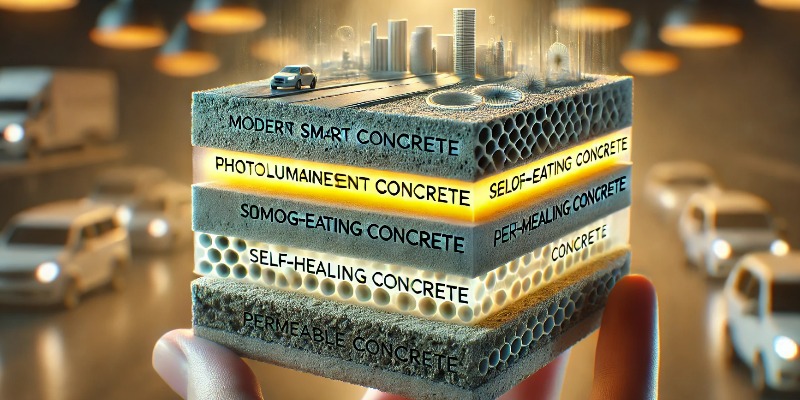
Construction, one of the oldest and most fundamental sectors of our society, is undergoing an epochal transformation. The growing environmental awareness, combined with the pressing need to address climate change and improve urban quality of life, is pushing the sector towards more innovative and sustainable solutions.
In this scenario, concrete, a cornerstone material of construction, is evolving to become "smart."
But what does "smart concrete" really mean? It refers to a material that integrates advanced technologies to improve its performance, durability, and environmental impact, addressing the needs of our time with intelligence and versatility.
The adoption of smart concretes represents a concrete response to many of the challenges our cities face today: from air pollution to water resource management, from the need for resilient infrastructures to healthier and safer buildings.
Below, we will explore seven types of smart concrete that are revolutionizing the construction sector, each with specific characteristics that enhance its use and maximize its effectiveness.
Photoluminescent
Imagine a road that absorbs sunlight during the day and glows at night without the need for electric power. This is photoluminescent concrete.
In the 1990s, photoluminescent pigments were initially developed for military and security purposes. Now, they are used to illuminate pedestrian paths, bike lanes, and roads.
The composition of photoluminescent concrete involves incorporating special pigments, such as strontium aluminates, which absorb sunlight during the day and release it slowly at night.
This feature not only improves safety but also helps reduce energy consumption.
Smog-Eating (Photocatalytic)
Next, we have smog-eating concrete, a true innovation for air quality. In the 1970s, scientists discovered the potential of titanium dioxide (TiO2) as a photocatalytic agent.
This material, when exposed to sunlight, triggers a chemical reaction that breaks down atmospheric pollutants like nitrogen oxides (NOx) and volatile organic compounds (VOCs).
Imagine a city where sidewalks and building facades help purify the air we breathe.
Photocatalytic concrete contains titanium dioxide, which, activated by sunlight, decomposes pollutants into less harmful substances like nitrates and carbon dioxide.
Self-Healing
Now think of concrete that repairs itself. In the 1990s, the concept of self-healing materials emerged, later applied to concrete in the 2000s.
This type of concrete contains chemical agents such as bacteria or microcapsules of cementitious material that activate upon contact with water.
When water penetrates cracks, these agents release lime that seals the fissures, preventing further damage and reducing maintenance costs. This innovation not only extends the life of structures but also offers a sustainable solution for infrastructure maintenance.
Permeable
Permeable concrete is another fascinating innovation. Developed in the 1960s to address urban flooding issues, this material is highly permeable, allowing rainwater to pass through it and reach the underlying ground.
Composed mainly of coarse aggregates and a minimal amount of cement, permeable concrete prevents surface water accumulation, improving stormwater management. It is ideal for parking lots, sidewalks, and roads in urban areas, where water management is a crucial challenge.
Living
A revolutionary idea in the world of concrete is living concrete, which emerged in the 2000s. Imagine a material that can interact with its surrounding environment.
By mixing photosynthetic materials with sand or hydrogel, living concrete can self-regulate in response to environmental conditions, helping to maintain an optimal internal temperature and improving the energy efficiency of buildings.
Moreover, photosynthetic materials can produce oxygen and absorb carbon dioxide, contributing to better air quality.
Space
Finally, consider space concrete, developed in the 2000s to withstand the extreme conditions of space.
This material is formulated with lunar or Martian regolith combined with high-strength binders, designed to endure extreme temperatures and space radiation.
It is perfect for building infrastructure on the Moon or Mars. Research on these materials also has significant implications on Earth, leading to the development of more resistant and durable concretes capable of withstanding severe environmental conditions.
Conclusion
Smart concretes represent the future of sustainable construction. By integrating innovative technologies, these materials not only enhance structural performance but also contribute to environmental protection and improved quality of life.
Continuing to invest in research and development in this field is crucial for addressing global challenges, providing efficient, durable, and sustainable construction solutions.
These innovations not only mark a step forward in material science but also respond to the growing demand for construction solutions that are efficient, durable, and environmentally friendly.