- Why choose a robot lawnmower for your garden
- How a Robot Lawnmower Works: A Beginner's Guide
- What to consider before purchasing a robot lawnmower
- Surface, slopes and obstacles: how to choose the right model
- Battery, autonomy and energy consumption of robot lawnmowers
- Smart connectivity and intelligent functions in modern models
- Robot lawnmowers and environmental sustainability: what to know
- The 3 best robot lawnmowers to buy
Discover how to choose the perfect robotic lawn mower for your needs, with technical tips, eco-friendly criteria, and the three best models available
Just a few years ago, lawn care meant investing time, effort, and a certain spirit of sacrifice—especially during the hot summer months.
Today, however, technology offers intelligent and sustainable solutions, and one of the most effective is the robotic lawn mower: a silent, efficient ally capable of keeping your garden neat without effort, while also optimizing energy consumption.
But beware: the market is vast and varied, and to purchase a product that truly suits your needs—and aligns with a responsible environmental vision—you need to look beyond technical specs. This guide was created to help you make an informed choice, going beyond trends and embracing the often-overlooked ecological dimension.
Why choose a robotic lawn mower?
The idea of completely outsourcing lawn mowing may seem futuristic, but it’s already a well-established reality. A robotic mower doesn’t just do the job for you—it does it better, more regularly, and with a level of efficiency that justifies the investment. Additionally, it eliminates the use of fossil fuels (in the case of electric models), reduces noise pollution, and encourages a new logic of lawn care: more frequent, gentler, and more natural.
Those who have used these devices know it: going back is hard. A consistently well-kept lawn, cut evenly, with clippings that transform into natural fertilizer (thanks to the mulching function), marks a real upgrade in everyday gardening. But to truly benefit from these advantages, choosing the right model is crucial.
How to choose the right robot: more than just size and price
The first mistake many buyers make is relying solely on power or price. In reality, there are several key factors to consider to understand which robotic mower best suits your garden.
The surface area to be covered comes first. Manufacturers always indicate a maximum surface area in square meters, which assumes ideal conditions. Practically speaking, if your garden is 400 m², it’s wise to choose a model rated for at least 500–600 m², to account for obstacles, flower beds, trees, and uneven terrain.
Terrain slopes are another critical element: not all robots can handle inclines over 25% or 30%. If you live in a hilly area or have a terraced lawn, you'll need a model specifically designed for slopes—even up to 45%.
Then there are the batteries, the energetic core of the device. The best ones are lithium-ion: they recharge quickly and last longer than old lead-acid batteries. But again, it’s not just about specs: how long does a single charge last in relation to the total area covered? Does the robot return to its charging station on its own? Does it have smart charging capabilities?
Another fundamental aspect is the cutting system. Some robots use a single blade, others have multiple rotating blades, and more advanced models can detect grass density and adjust speed and cutting height in real time. The mulching function, furthermore, eliminates the need to collect clippings, making the process more natural and eco-friendly.
Finally, connectivity can make a big difference. Increasingly, models can be controlled via smartphone apps, and some integrate voice commands with Alexa or Google Home, personalized scheduling, and even geofencing to prevent them from wandering outside the set boundary.
Those looking for convenience and smart living should seriously consider these features.Robotic lawn mowers and sustainability: a green choice
Not all robotic mowers are equally eco-friendly. While they are all electric—and therefore cleaner than traditional gas-powered models—there are specific sustainability metrics to evaluate:
- Energy consumption: the most efficient models use less than 20 kWh per month, a low figure especially when compared to the environmental cost of fuel and traditional maintenance.
- Battery life: long-lasting batteries reduce the need for frequent replacements, preventing premature waste.
- Materials used: some manufacturers are now using recycled plastics for the chassis and minimal, sustainable packaging.
- Solar compatibility: certain models allow the charging station to be paired with a small solar panel.
Choosing an efficient model not only lowers your electricity bill but also reduces your home’s environmental footprint—a practical step toward a more responsible lifestyle.
Three recommended robotic mowers
Out of the many models available, we’ve selected three that stand out for build quality, intelligent operation, and environmental awareness. Here are our top picks for a conscious purchase:
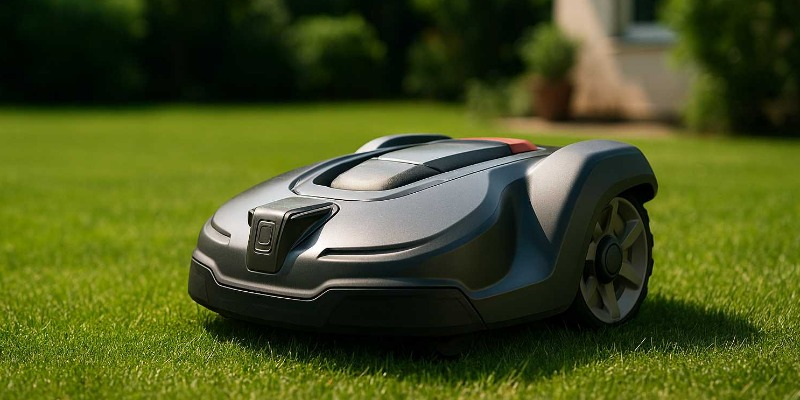
1. Husqvarna Automower 315 Mark II
Perfect for complex lawns up to 1500 m², this model features an advanced cutting system that adapts to various terrain conditions. Extremely quiet, easy to program, and capable of handling slopes up to 40%, it’s a high-quality investment designed to last.
A smart, modular mower designed for areas up to 500 m². Thanks to AI, it optimizes paths based on the garden’s layout. It’s customizable with optional modules (garage, GPS, ultrasonic sensors) and is compatible with Alexa.
Compact, affordable, and perfect for small green spaces (up to 250 m²), this is one of the quietest models available. Ideal for urban gardens or small courtyards, it’s managed easily via a user-friendly app.
Conclusion: the lawn mower of the future is quiet, sustainable, and smart
Choosing a robotic lawn mower isn’t just about saving time—it’s about improving the quality of your outdoor space, reducing environmental impact, and investing in practical, forward-thinking technology. Understanding technical features, evaluating your specific garden needs, and relying on trusted brands are essential steps toward a smart and sustainable purchase.
In the end, mowing the lawn is no longer a chore—it’s a matter of artificial intelligence. And nature will thank you for it.
© All rights reserved – Reproduction prohibited