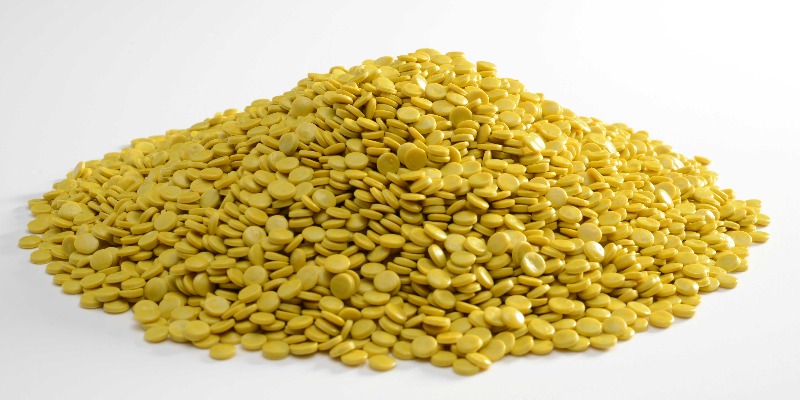
- From recovered material to designed material: the role of formulations in recycled polymers
- PE/PP blends and mixed rigids: microstructure, incompatibilities and compatibilization strategies
- Compatibilizers for recycled polyolefins: molecular bridges between immiscible phases in rigid blends
- Mineral fillers in recycled plastic: talc, CaCO₃ and organo-modified silicates as internal architecture
- Glass and natural fibers in recycled polymers: designing mechanical reinforcement without losing workability
- Chain extenders and rheological modifiers: rebuilding molecular weight and stabilizing flow in recyclates
- Thermal-UV stabilization systems for recycled plastics: protecting color, performance and service life
- From recipe to finished product: connecting formulation, industrial process, and performance of post-consumer plastics
How to design post-consumer polymers competitive with virgin ones through PE/PP blends, mineral fillers, fibers, chain extenders and thermo-UV stabilization systems
Essay. Post-Consumer Plastics Recycling. Chapter 14: Advanced Formulations for Recycled Plastics. High-Performance Blends, Fillers, and Additives
The world of formulations for recycled materials represents the point at which regenerated plastic ceases to be a simple "recovered" material and becomes a designed, calibrated, and molded substance. While the selection, washing, and production of the granules have yielded a clean, stable, and controlled secondary raw material, it is only through formulations that this material acquires new properties, improved functionality, and truly competitive performance compared to virgin polymers. Formulation is the language of engineering applied to recycled materials: a grammar that combines polymers, additives, fillers, and modifiers with a precision similar to that of advanced materials chemistry.
In modern manufacturing, no plastic material—virgin or recycled—is used in its "pure" form. The performance required in final products is too high to rely on the polymer's intrinsic characteristics. Formulation bridges the gap between what the material is and what it needs to become: more resistant, more stable, more workable, higher-performance. For recycled materials, this transition is not just an opportunity but a necessity: each batch carries with it the memory of previous uses, the complexity of a non-uniform thermal history, and a natural variability that must be brought back into order.

The main challenge of formulating with recycled materials lies precisely in their heterogeneity.
One post-consumer polyethylene is never identical to the next; a PP made from rigid blends brings with it differences in density, melt flow rate, and original additives; a PE/PP blend from urban waste contains intrinsic incompatibilities that must be resolved to achieve a continuous phase. Where virgin material offers repeatability, recycled offers complexity; where virgin guarantees purity, recycled requires formulation intelligence......© Reproduction Prohibited