- Italy and cycling culture: still an uphill battle
- Bolzano, Pesaro, and Ferrara: cities that symbolize sustainable mobility
- When pedaling becomes a gesture of balance and freedom
- The gentle revolution of the "30 Cities" in Europe and Italy
- From traffic to slowness: changing mentality before infrastructure
- Cycling as a Lifestyle: The Slow Philosophy in the Heart of the City
- Pedaling to reconcile with time, the body and urban space
- Towards a sustainable future: Italy rediscovers the rhythm of slowness
A journey into the culture of cycling as a lifestyle, not just a means of transport
by Marco Arezio
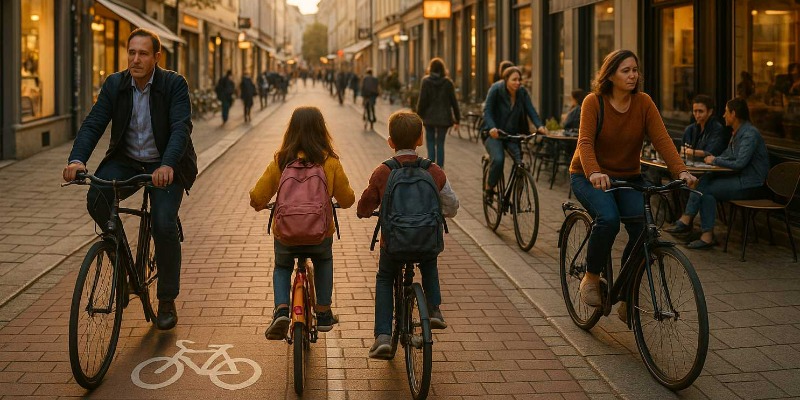
There's a rhythm that modern life has almost forgotten: that of pedaling. It's the slow pace of those who traverse the city not to dominate it, but to inhabit it. It's the calm trajectory of those who choose the bicycle not just to get around, but to rediscover a sense of time, the measure of space, and the ability to listen to their bodies.
In Italy, however, this pace is still a whisper amid the roar of motors. The numbers tell a bitter truth: only 4% of Italians regularly use bicycles to get around. In our cities, 80% of urban space is still given over to cars. Two-wheelers, a universal symbol of freedom and lightness, remain confined to the margins: broken lanes, dangerous crossings, uncertain signage.
Yet, something is moving — even if uphill.
Bolzano, Pesaro, Ferrara: where slowness is already a value
There are places where cycling isn't a heroic choice, but a daily occurrence. In Bolzano, 28% of trips are made on two wheels. In Pesaro and Ferrara, the percentage is similar. Here, soft mobility isn't just infrastructure, it's a shared culture.
Cities that truly cycle have learned a fundamental lesson: it's not enough to simply lay out bike lanes; we need to change our mindset. We need to think of urban space as a breathing organism, where every movement—on foot, by bike, by bus—becomes part of a collective rhythm.
In Pesaro, the "Bicipolitana" is a prime example: colorful bike lanes connecting neighborhoods, schools, offices, parks, and beaches, like a true metropolitan cycling network. Ferrara, on the other hand, has transformed the bicycle into a symbol of its identity: a city measured in pedal strokes rather than kilometers.
The real change is cultural, not just infrastructural
When we talk about sustainable mobility, the temptation is to count kilometers of lanes, European funding, and incentives. But profound change isn't measured in meters of asphalt, but in meters of awareness.
It's a matter of civic and sensorial education. Of mutual respect. Of daily choices. Cycling is neither a luxury nor a sacrifice; it's a declaration of balance. It's a political gesture in the purest sense of the word: choosing a lifestyle that removes space from noise and restores it to silence.
In a country where traffic takes away hours of life and pollution affects the health of millions, cycling isn't just about ecology, it's a form of gentle resistance. It's saying, "I want to live at a different speed."
30 Cities: The (Slow) Future That Can Save Us
Europe is moving—or rather, slowing—toward an urban model where 30 km/h speeds become the norm. "30 Cities" aren't utopias: they are the future of civil coexistence. Reducing speed means increasing safety, reducing noise, giving back space to children and the elderly, encouraging local shops, and reviving the social life of the streets.
Italy is timidly starting to talk about it. Bologna and Cesena have launched the first projects; other cities are watching with curiosity, some with skepticism. But the European data speak clearly: where speeds are lowered, quality of life improves. And not just for cyclists.
Cycling as an act of conscious slowness
There's a forgotten pleasure in cycling: the wind on your face, the scent of the seasons, the freedom to pause. It's an act that unites body and mind, a small daily ritual of sustainability.
In the world of slow life, the bicycle is more than just mobility: it's meditation in motion. It's a tool that reconciles the individual with the landscape, bridging the gap between home and work, city and nature, speed and balance.
The real challenge is not building bike lanes, but building a new collective imagination in which cycling becomes a normal, desirable, even elegant act.
A country to be reconciled with its rhythm
Perhaps the problem isn't that Italy doesn't pedal: it's that it's forgotten how to do it calmly. We've allowed haste to become a virtue and slowness a flaw. But the bicycle reminds us that balance is found only in measured movement, in regular breathing, in the patience of the journey.
Every time we choose a bike, we choose to belong to a silent but growing community. A community of those who believe that the future isn't built by speeding up, but by learning to slow down together.
© Reproduction Prohibited