- Introduction to non-traditional storage batteries
- Environmental and industrial limits of conventional batteries
- Water-based batteries: technologies, advantages and applications
- Redox flow batteries: structure, operation and prospects
- Solid-state batteries with alternative electrolytes
- Organic and polymer batteries in the circular bioeconomy
- Carbon dioxide (CO₂-based) storage batteries
- Biodegradable batteries: paper-based solutions and biobatteries
- Integration of new batteries into the circular economy
- Future prospects and challenges of sustainable batteries
Technical analysis of advanced batteries based on alternative materials and sustainable processes for a circular energy future
by Marco Arezio
Energy storage represents one of the main technological and environmental challenges of the transition to decarbonized and distributed energy systems. The expansion of renewables, the growth of electric mobility, and the digitalization of networks require storage solutions that are not only efficient but also sustainable.
While lithium-ion batteries have dominated the market for over a decade, the technical landscape is rapidly evolving toward non-traditional alternatives designed to reduce environmental impact, promote recycling, and facilitate integration into a truly circular supply chain. Innovation in this sector aims to overcome the limitations of conventional technologies by adopting more abundant materials, less polluting manufacturing processes, and architectures geared toward a sustainable lifecycle.
Limitations of conventional batteries and the urgency of innovation
Lithium-ion technology, now ubiquitous in portable devices, electric vehicles, and stationary storage systems, raises several sustainability issues. The mining of lithium, cobalt, and nickel entails significant environmental impacts: intensive water use, CO₂ emissions, toxic waste production, as well as social and geopolitical challenges related to the concentration of mines in just a few areas of the planet.
Furthermore, the life cycle of lithium batteries is still complex and expensive to recycle, with high costs and processes that often prevent the full recovery of valuable materials. In this scenario, there is a growing need to develop storage systems that meet eco-design criteria, use of secondary materials, recyclability, and minimal social impact.
Non-traditional storage battery families: technical classification
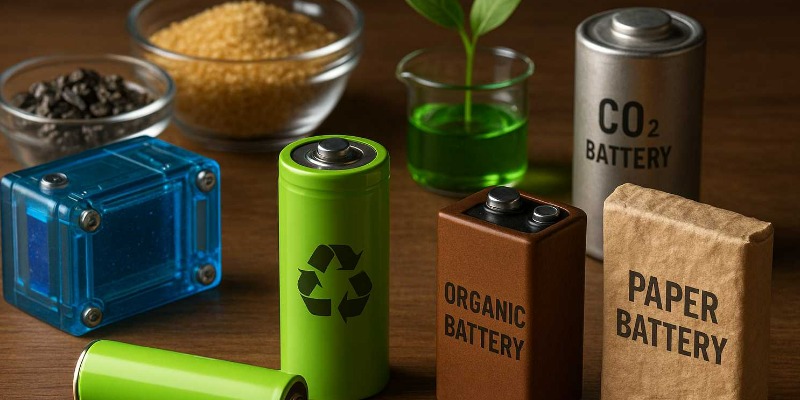
In the context of research and industry, non-traditional batteries can be divided into several macro-families, all characterised by a strong sustainability and circularity footprint:
- Water-based batteries (Zn-air, Zn-MnO₂, Fe-Ni, etc.)
- Redox flow batteries
- Solid-state batteries with alternative electrolytes
- Organic and polymer batteries
- Carbon dioxide (CO₂-based) batteries
- Paper-based batteries and biobatteries
Let's look at them in detail, paying attention to the technical aspects, advantages, and critical points of each.
Water-based batteries: safety and abundant raw materials
Batteries that use aqueous electrolytes and common electrode materials (such as zinc, manganese, iron, nickel) represent one of the most attractive solutions from a sustainability perspective. Using water as an electrolyte offers greater safety than organic solvents, reducing the risk of fire and explosion.
Technical examples:
- Zn-air batteries: These exploit the oxidation of zinc and the reduction of atmospheric oxygen. They offer high theoretical energy density, low cost, and simple construction, but present challenges in terms of cyclability and dendrite formation.
- Zn-MnO₂ batteries: Traditionally used as disposable batteries, rechargeable versions are emerging thanks to new stabilized electrolytes.
- Fe-Ni batteries: Edison's "old" batteries, now revalued for their low cost and ease of recycling.
These systems are ideal for stationary applications, light mobility and contexts where safety and ease of end-of-life recovery are priorities.
Redox flow batteries: modularity and long life
Redox flow batteries are characterized by the physical separation between capacity (determined by the amount of liquid electrolyte) and power (defined by the cell surface area). The most common solutions use vanadium, but alternatives based on iron, bromide, and, above all, organic molecules are emerging.
Advantages:
- Lifespan greater than 10,000 cycles
- Ease of maintenance and upgrade
- Possibility of reusing the electrolyte infinitely
On the sustainability front, systems with organic electrolytes (derived from biomass or industrial byproducts) are currently the subject of intense research, with a view to a completely green supply chain. Limitations include high initial costs and the need for dedicated facilities, but for large-scale stationary storage, these batteries represent one of the most promising solutions.
Solid-state batteries with alternative electrolytes: safety and secondary materials
The evolution of solid-state batteries focuses on new ceramic or polymer electrolytes, combined with non-critical electrode materials such as sodium, magnesium, or calcium.
Technical focus:
- Solid-state sodium-ion batteries: they exploit sodium, which is abundant and readily available, for applications that require high safety and low costs.
- Magnesium and calcium batteries: systems under development that promise very low costs, high theoretical density, and fewer dendrite problems than lithium.
Recycling these batteries is simplified by the absence of toxic liquids and the nature of the materials used, facilitating the design for disassembly and second life of the components.
Organic and polymer batteries: towards a bio-circular economy
An emerging and particularly dynamic field is that of batteries based on organic materials: conductive polymers, quinones, nitrogen-based compounds and other extracts from biomass or green synthesis.
Main advantages:
- Use of renewable materials or materials derived from agro-industrial waste
- Low toxicity and potential biodegradability
- Easy to recycle and disassemble
The main challenges remain long-term stability, moisture resistance, and even lower energy density than metal solutions.
However, the potential for large-scale applications is high, especially in contexts where environmental impact outweighs pure performance.Carbon dioxide (CO₂-based) batteries: integrated storage and decarbonization
One of the most innovative and promising frontiers in the sector is represented by batteries that use CO₂ as an active element in the electrochemical process, integrating energy storage and carbon capture strategies.
Operating principle
These batteries, typically called metal–CO₂ batteries (lithium–CO₂, sodium–CO₂, potassium–CO₂), use metal anodes that react with carbon dioxide during discharge, forming solid products (carbonates or oxalates) and releasing energy. During charging, the reaction is reversed, allowing for the controlled release of CO₂ or its conversion into other useful substances.
Sustainability and circularity
- CO₂ capture and recovery: these batteries allow CO₂ capture to be integrated into energy-intensive industrial processes, transforming a greenhouse gas into a storage resource.
- Abundant and recyclable materials: Sodium–CO₂ and potassium–CO₂ systems use widespread and easily recyclable metals.
- Easy recovery of by-products: the carbonates formed can be separated and reused in industrial or chemical processes, reducing the need for disposal.
Technological challenges and prospects
The stability of charge/discharge cycles, solid byproduct management, and energy efficiency remain the main critical issues, along with the need for increasingly high-performance catalysts. However, working prototypes are currently being tested at major research centers (MIT, Stanford, and European institutions) and could become a strategic solution for industries such as cement plants, heavy chemicals, and power generation plants, which already emit large amounts of CO₂.
CO₂-based batteries therefore represent a technical and circular response to the dual need for storage and decarbonisation, with growth prospects over the next ten years.
Paper-based batteries and biobatteries: biodegradable solutions for consumer electronics
The push towards ubiquitous electronics and the Internet of Things has led to the development of fully biodegradable batteries, built on conductive cellulose substrates or powered by enzymes and microorganisms.
These systems are ideal for temporary applications (smart labels, disposable environmental sensors, single-use medical devices), where ease of disposal and low environmental impact are top priorities.
The challenges mainly concern limited power and endurance, but the potential for an entirely green cycle is now a reality.
Integrating sustainable systems into the circular economy
The true revolution in non-traditional batteries isn't just about the materials used, but the adoption of design-for-recycling strategies, modularity, digitalization of flows, and "second-life" platforms that extend the product's useful life before final recycling.
Industry best practices include:
- Design of easily separable cells and modules, with digital traceability
- Implementation of advanced health diagnosis platforms
- Low-impact hydrometallurgical recovery and biotechnologies for material separation
- Development of business models such as “battery as a service” and extended producer responsibility
Case studies and industrial applications
- Stationary storage and microgrids: Flow and water-based batteries are finding use in local microgrids and backup systems, thanks to their low costs and long operating life.
- Sustainable mobility: Sodium-ion, zinc-air, and CO₂-based batteries are candidates for light-duty vehicles, shared fleets, and low-impact urban mobility solutions.
- Disposable Electronics and IoT: Organic and paper-based batteries are revolutionizing the industry of smart labels, sensors, and short-cycle smart devices.
Future prospects: research, regulation and market
The path to truly circular energy storage is marked by a convergence of technological innovation, more stringent regulations (such as new European regulations on liability and recyclability), and growing demand for responsible solutions.
The research priorities include:
- Optimization of energy density and cyclability in organic and CO₂-based systems
- Automation and digitalization of selection, disassembly and recycling processes
- Traceability via blockchain and digital platforms for lifecycle management
In this scenario, the competitiveness of non-traditional batteries is set to grow, driving a profound transformation of the global energy supply chain.
Conclusion: sustainable storage, the driving force of the ecological transition
The future of storage batteries is already partly determined by the ability to combine technical innovation, environmental responsibility, and new circular business models. The non-traditional solutions analyzed—from water-based to CO₂-based batteries, from organic to paper-based—demonstrate a supply chain undergoing profound transformation, capable of supporting the energy transition while reducing dependence on critical resources and minimizing environmental impact.
Addressing the remaining challenges of cost, performance, and scalability will be crucial, but the direction is clear: storing energy without storing problems, toward a more resilient, equitable, and clean energy future.
© Reproduction Prohibited