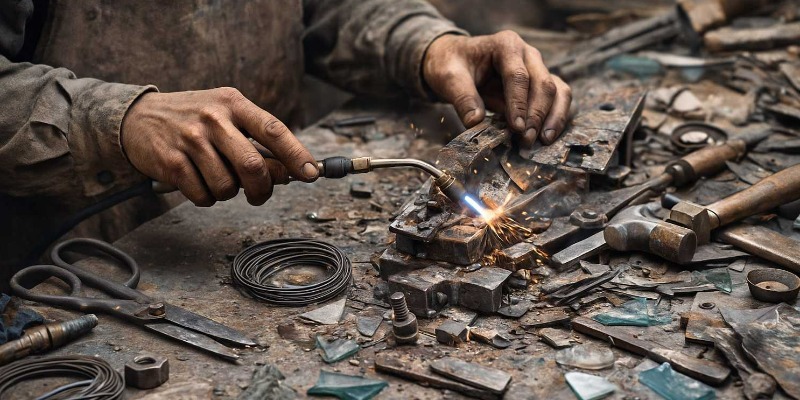
This chapter explores the beating heart of artistic recycling: the moment when collected material becomes form through gesture, craftsmanship, and technique. Transformation is not simply a physical act, but an intimate dialogue between the artist and materials marked by time, breakage, and use. Cutting, pressing, heat, twisting: each technique reveals unpredictable reactions that demand listening and respect.
Ancient tools and modern technologies coexist, not in opposition, but in an alliance capable of making the hidden history of waste visible. Mistakes become opportunities, breaks transform into traces of memory, stitching into gestures of care. Transformation, ultimately, changes not only the materials, but the artist himself: it teaches him to leave room for the unexpected, to recognize value in imperfection, to see potential where others see waste.
Cutting, melting, assembling and constructing: how the transformation of recycled matter becomes a creative language and a poetics of imperfection
Essay. New Matter. Chapter 11: Techniques, Hands and Materials in Artistic Recycling
Every material finds its meaning at the moment it is transformed. Before transformation, it is only potential: a promise, an intuition — a fragment collected on the street, a forgotten household object, a piece of oxidized metal found on a construction site, a torn fabric retrieved from a landfill. Matter, on its own, is not enough: it needs a gesture that makes it meaningful. Not a random gesture, but one guided by skilled hands and by technical knowledge capable of listening to the material before intervening on it.
Transformation techniques are where recycling art becomes real. They are the point where thought becomes hand, where ideas gain weight, consistency, temperature. Recycling is not an abstract process: it is physical labor, filled with dust, noise, and smells. It places the artist in direct contact with the resistance and docility of matter, with its limits and its hidden resources. Every material reacts differently to cutting, pressure, heat or torsion: knowing these reactions means knowing the secret language of matter.

Manual skill is the first tool.
There is no transformation without hands that touch, test, fail and try again. An artist who works with recycled materials must develop a different kind of manual ability compared to those who use new, standardized materials: they must learn to read irregularities, fragilities and compromised areas. Rusty metal does not cut like new sheet metal; recycled glass does not engrave like industrial crystal; worn fabric does not behave like fresh textile from a factory. Every material requires its own way of being held, supported and transformed without betraying its nature.....