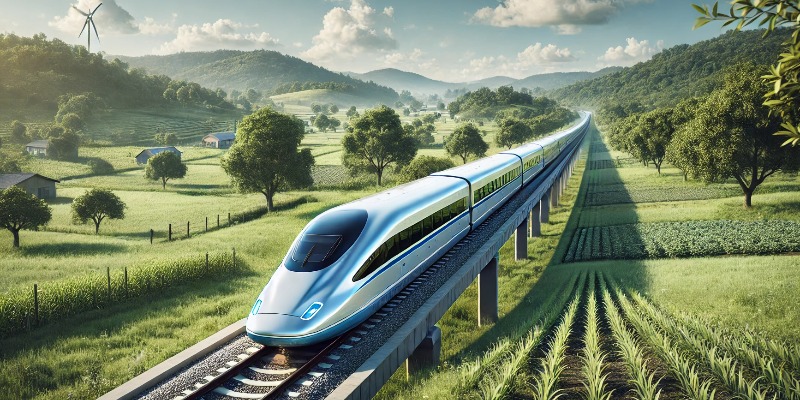





- Maglev Trains: The New Era of High-Speed Transportation
- Maglev Technology: How Magnetic Levitation Works
- The History of Levitation Trains: From the Origins to Current Advances
- Advantages of Maglev: Speed, Efficiency and Noise Reduction
- The 600 km/h Maglev: A Technological Leap for China
- China and Japan: Global Leaders in Maglev Development
- Maglev and Logistics: A Comparison with Air and Naval Transport
- Sustainability and Transportation: The Role of Maglev in the Future of Global Mobility
The revolution of magnetic levitation trains is reshaping the future of freight and passenger transport, offering a fast, efficient, and eco-friendly alternative to air and sea transport
by Marco Arezio
Land transport has always aimed to combine speed, efficiency, and sustainability. Today, this ambition seems to find one of its most advanced expressions in magnetic levitation trains, known as Maglev.
These trains can reach incredible speeds, as demonstrated by the latest Chinese project, which developed a train capable of reaching 600 km/h.
This technology represents a revolution not only for passenger travel but also for freight transport, and it promises to radically change how we conceive movement on land.
Thanks to magnetic levitation, Maglev trains eliminate friction, offering faster, quieter, and lower-energy impact journeys compared to traditional means.
But how does this technology compare to other forms of transportation, such as air and sea transport?
The history of magnetic levitation rail transport
The idea of transportation based on magnetic levitation emerged at the beginning of the 20th century, but it only began to take shape in the mid-1900s.
In 1934, German scientist Hermann Kemper obtained the first patent for a transport system that used magnetic fields to levitate and move a vehicle. However, the technology was not yet mature, and the idea remained theoretical for many years.
It was in the 1960s that Germany and Japan began investing in the development of the first magnetic levitation train prototypes.
In Germany, the "Transrapid" system became a symbol of technological research, while Japan worked on electrodynamic levitation (EDS), a technology that would lead to the development of the famous Chūō Shinkansen, Japan’s Maglev train.
The first commercial use of Maglev occurred in China in 2003, with the inauguration of the line connecting central Shanghai to Pudong International Airport, with a maximum speed of 431 km/h. This event marked the beginning of practical use of a technology that, until then, had been considered futuristic.
How magnetic levitation works
Maglev relies on the interaction of magnetic fields that lift the train off the tracks, eliminating physical contact. This is achieved through powerful electromagnets installed both in the train and along the track.
The two main types of magnetic levitation systems are:
Electromagnetic Suspension (EMS): In this system, electromagnets on the train attract the vehicle toward the tracks, keeping it suspended at a constant distance. Stability and distance from the track are actively controlled through electronic systems that ensure smooth and safe movement.
Electrodynamic Suspension (EDS): Here, levitation is achieved through superconductors or permanent magnets placed on the train, which interact with currents induced in the tracks. This system requires the train to be in motion to generate levitation, and once activated, the train remains suspended without the need for additional energy.
These systems allow Maglev to eliminate mechanical friction, enabling very high speeds and significant noise reduction, unlike conventional trains.
The advantages of Maglev
Maglev trains offer several advantages over traditional rail transport systems:
Speed: Maglev trains can reach speeds over 600 km/h, making them one of the fastest options for land transport. Compared to traditional high-speed trains, which travel at around 300-350 km/h, Maglev can drastically reduce travel times over medium and long distances.
Lower maintenance costs: Since there is no physical contact between the train and the tracks, component wear is reduced, leading to lower maintenance costs and greater infrastructure durability.
Energy efficiency: The reduction of mechanical friction makes Maglev more energy-efficient compared to traditional trains, especially at high speeds. This makes it a more sustainable technology, especially when powered by renewable energy sources.
Comfort and noise reduction: The lack of friction between wheels and tracks ensures a smoother and quieter ride than traditional trains, improving the passenger experience.
The performance of the 600 km/h Maglev train
The Maglev train developed in China, capable of reaching 600 km/h, represents the pinnacle of performance currently achievable for a land transport vehicle.
This train can reduce travel times between major cities like Beijing and Shanghai, which take about 4 hours by plane, to less than 2.5 hours.
With such speed, Maglev becomes a direct competitor to air transport on regional and intercity routes, offering an equally fast but potentially more economical and environmentally sustainable alternative.
Leading nations in the Maglev train sector
The global landscape of Maglev currently sees two countries at the forefront: China and Japan.
China: The Chinese government has heavily invested in the development and commercialization of Maglev. The Shanghai line and the new 600 km/h train are part of a strategy to expand the transport network, aiming to connect major Chinese cities in record times.
Japan: Japan, a pioneer in high-speed train technology, is developing the Chūō Shinkansen, a Maglev line that will connect Tokyo and Nagoya in about 40 minutes, with a projected speed of over 500 km/h. Japanese technology is primarily based on electrodynamic levitation, which has shown impressive results in tests.
Comparison of Maglev freight transport with sea and air transport
Maglev’s potential is not limited to passenger transport. In the freight sector, this technology could bring significant changes, especially compared to traditional systems like sea and air transport.
Sea transport: Ships are the primary mode of transport for international trade, particularly for large quantities of goods. However, sea transport is extremely slow. Cargo ships take weeks to move goods across oceans.
In comparison, a Maglev freight system could offer significantly reduced delivery times over continental or interregional distances, such as those between major ports and inland industrial areas.
While Maglev might not fully replace sea transport for bulk cargo, it could complement supply chains for perishable or high-value goods, improving efficiency in the final stages of distribution.
Air transport: Air transport is currently the fastest mode for long-distance freight transport. However, it is also among the most expensive and environmentally impactful due to the high fuel consumption of airplanes.
Maglev, with speeds comparable to airplanes on medium-range routes, could effectively compete in delivery times, with much lower energy and environmental costs. Specifically, Maglev could replace air transport on regional or continental routes, offering a more sustainable alternative.
Conclusion
The Maglev train represents one of the most promising innovations in the transport sector. With its impressive speed, reduced operating costs, and lower environmental impact, Maglev not only revolutionizes passenger transport but also opens new prospects for freight transport, offering a faster and more sustainable alternative to conventional methods like air and sea transport.
Countries like China and Japan are leading this technological revolution, and their experiences could soon inspire other nations to invest in this promising technology.