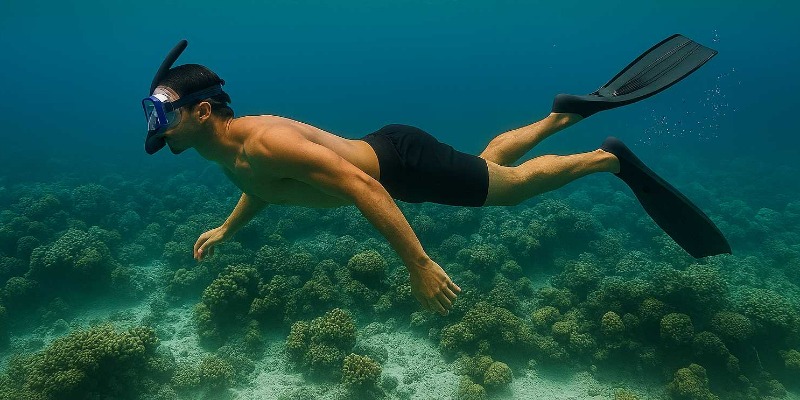
- Industrial production of diving fins: materials and technologies
- Designing diving masks between comfort and safety
- The use of technical polymers and composites in diving
- Molding and assembly techniques for diving equipment
- The challenges of recycling mixed materials in fins and masks
- Downcycling and upcycling: post-consumer recovery strategies
- Sustainable design and circularity in the underwater sector
- Current products and market orientation towards sustainability
- Main companies in the sub sector
A technical analysis of production processes, materials used, and circular economy prospects for diving equipment
by Marco Arezio
In the world of diving, equipment efficiency isn't just a matter of comfort or aesthetics: it directly impacts diver performance, safety, and, increasingly, environmental impact.
Among the essential tools accompanying every dive—professional, sport, or recreational— fins and masks stand out for their intensive use and engineering complexity. A thorough understanding of how these objects are designed and manufactured is essential for those involved in industrial recycling, eco-design, or the circular economy applied to durable consumer goods. This is especially true at a time when the ecological transition requires a review of the entire life cycle of plastic and composite products.
A balance between mechanical resistance and flexibility
The design of diving fins follows a key principle of materials engineering: balancing the structural rigidity needed to transmit muscle power with the elastic flexibility that returns energy for propulsion. Fins are most often composed of two distinct functional sections: the foot pocket, which accommodates the diver's foot, and the blade, which provides propulsion through the water.
The innerboot is usually made of thermoplastic elastomers (such as TPE or SEBS) , appreciated for their morphological adaptability and cushioning properties. These materials have good resistance to hydrolysis, UV rays, and salt, and are easily injection molded, making them compatible with high-volume serial production.
The blade, however, requires greater rigidity. Technical polymers such as high-density polypropylene are often used , but high-end versions employ composite materials such as epoxy resins filled with glass or carbon fibers. These materials provide directional elastic behavior (mechanical anisotropy) that allows for differentiated response during flexion and rebound, maximizing energy efficiency. Carbon, while guaranteeing superior performance in terms of lightness and reactivity, nevertheless poses challenges at the end of the product's life due to the impossibility of mechanical recycling.
The liner and blade can be assembled using direct overmolding, two-component co-injection, or mechanical fastening. The first option allows for a monolithic structure, less prone to leaks and breakages; the latter two facilitate disassembly and replacement, favoring repairability.
Diving masks: ergonomics, vision, and safety
When it comes to masks, industrial design is deeply intertwined with human physiology. The mask must create a stable and comfortable air chamber between the face and the lens, preventing water infiltration and fogging. The materials used for the seal in contact with the skin are mostly silicone, both cross-linked and thermoplastic . Silicone rubber is preferred for its hypoallergenic properties, elastic memory, and durability, although it presents recycling challenges.
The body of the goggle, or the frame that supports the lens, is usually made of ABS or polycarbonate: rigid, lightweight materials that are resistant to impact and deformation. The glass used for vision is almost always tempered glass, whose heat treatment makes it shatterproof, meaning it shatters into smooth particles if broken, preventing cuts and accidents.
Recent years have seen the rise of full-face masks, which combine a visor and respirator in a single unit. These versions are more complex to engineer and require more complex assembly, with mixed materials and internal valves. Consequently, they are also more difficult to disassemble and recycle, unless specifically designed.
Life cycle and recycling strategies
The end-of-life of fins and masks poses significant environmental challenges. Once these products have lost their elasticity, transparency, or durability, they are often destined for landfill, especially in tourism or non-specialized sports settings. However, some recovery strategies can represent an interesting paradigm shift.
The first option is mechanical recycling of thermoplastic components, such as TPE, PP, ABS, and polycarbonate. This process involves shredding, separation using density or infrared technology, and finally extrusion into granules for new products. However, the presence of composite materials or metal inserts can contaminate the flow and reduce the quality of the recycled product.
The second approach is chemical recycling, which allows—at least theoretically—to depolymerize even the most complex plastics and return reusable monomers. But this process is still economically expensive and only available in experimental or pilot-scale plants.
More accessible is so-called downcycling , or the reuse of degraded plastics in less noble applications, such as the construction industry (filling, panels, flooring), street furniture, or technical footwear. Some manufacturers have already developed product lines made from old fins and masks, especially in countries where diving tourism generates large quantities of waste.
Another front is creative upcycling , which has found application in artistic and design contexts. Carbon fiber blades, for example, can be transformed into decorative panels or nautical furnishings, while discarded masks find a home in scenic or museum displays.
Finally, sustainable design policies (ecodesign) are also beginning to spread in this sector.
Products designed to be disassembled, repairable, and recyclable extend their useful life cycle and enable a circular economy approach. Some manufacturers already offer end-of-season collection and recovery systems, or modular spare parts that are easily replaceable by the end user.The market and the sustainability-oriented offer
The current market offers an interesting range of products that, while not yet fully sustainable, incorporate durability, ease of recycling, and lower-impact materials.
Among the fins, a particularly interesting model is the Seac Propulsion, made of high-performance composite materials but designed to be easily separated between the foot pocket and the blade.
Cressi Pluma Fins, on the other hand, uses the Cressi (patented) 3-material moulding construction system to obtain high performance, great lightness and ease of finning, extraordinary comfort
Finally, Mares Plana Avanti Tre with its design and construction materials make the fins ideal for recreational diving but also for snorkeling in warm waters.
For masks, the Jemulice Set stands out for its removable structure in tempered glass and silicone, which facilitates the separate recycling of the components.
The Lamker full-face, despite its structural complexity, integrates an anti-fog system and panoramic vision, offering an advanced experience.
The Epsealon Explorer, finally, presents itself as a hybrid model between performance and sustainability, with resistant materials and simplified construction.
Some companies specialized in the underwater sector
A historic Italian brand founded in 1946, Cressi is a world leader in the diving equipment industry. Its products, manufactured primarily in Italy, are renowned for their high quality, durability, and performance. The company has embarked on a sustainability journey that includes greater use of durable materials, low-impact manufacturing processes, and reduced packaging. However, full environmental traceability of its products remains an area for further development.
Mares, part of the HEAD Group, is another global leader in technical and recreational diving. Its products combine technological innovation and durability, with a growing focus on choosing less impactful materials. The company has introduced masks and fins with removable components and is working to improve the recyclability of its products. It has also promoted educational campaigns related to the protection of marine ecosystems.
Specializing in water recreation products, Bestway offers entry-level and inflatable items, often aimed at the general and seasonal market. Although it offers a wide range of affordable masks and fins, the perceived quality is lower than that of technical brands. In terms of sustainability, Bestway has launched projects to reduce the use of PVC and plastic packaging, but the high turnover and short shelf life of its products limit their long-term positive impact.
SEAC (Società Esercizio Apparecchiature Costruzione) is an Italian company known for its functional design and high-quality materials. SEAC fins and masks are often designed for intensive and professional use. The company has introduced several lines using recyclable materials and a transparent production chain, maintaining high ergonomic and performance standards. It is also investing in eco-friendly design and modular components.
Conclusion
The production of fins and diving masks represents an emblematic field where the demands of technical performance, safety, ergonomics, and environmental sustainability intertwine. Although the construction technologies are now well-established, future challenges lie in the ability to reinvent the product life cycle, reducing the use of difficult-to-recycle materials, simplifying assembly, encouraging reuse, and designing from the outset with decommissioning in mind.
From this perspective, the role of the recycling sector—along with that of university research—is crucial in developing systemic and scalable solutions. Through greater collaboration between manufacturers, treatment centers, and designers, it will be possible to transform underwater equipment from potential waste into new resources, truly closing the plastic cycle, even at depth.
© Reproduction Prohibited