- Italy in the 1980s and the birth of the Panda
- Giorgetto Giugiaro and the philosophy of functional design
- The Panda as an industrial response to the energy crisis
- Minimalism and rationality: form follows function
- Ergonomics and accessibility in the Panda project
- Industrial sustainability ante litteram
- The Panda 4x4 and the expansion of the myth
- The cultural and stylistic legacy of the Panda in the 21st century
Minimalism, ergonomics and accessibility: how the Panda became an icon of industrial sustainability and rational design, embodying the Italy of work and ingenuity in the 1980s
by Marco Arezio
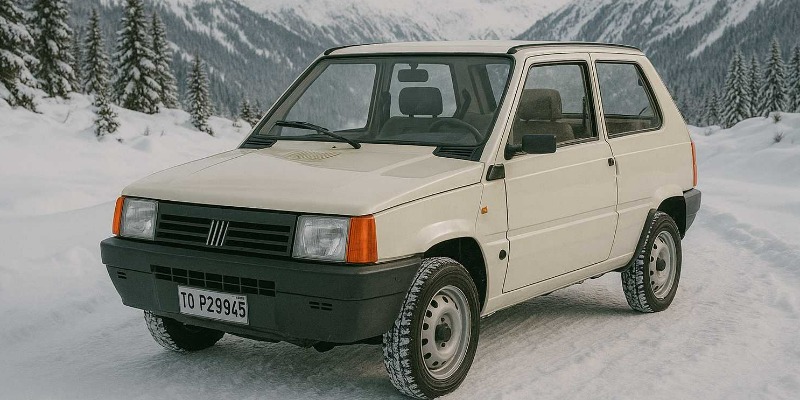
In 1980, when the Fiat Panda appeared on Italian roads, no one imagined that this small, boxy utility vehicle would become one of the greatest symbols of twentieth-century industrial design. Designed by Giorgetto Giugiaro for Fiat, the Panda was born at a time of profound economic and social transformation: Italy was leaving behind the 1970s—rife with energy crises, austerity, and social tensions—to enter a new decade of pragmatism and the search for a balance between innovation, accessibility, and sustainability.
The Panda, seemingly simple and even "poor," was actually a brilliant design in its essentiality: a car designed not to amaze, but to serve. Every line, every material, every design choice responded to a functional logic. In this sense, Giugiaro did something radical: he brought automotive design back to its original purpose—form as a direct consequence of function—in a period when cars increasingly tended to prioritize aesthetics or power over practicality.
A Changing Italy: Industrial and Social Context
At the dawn of the 1980s, Fiat was still the industrial giant that dictated the pace of the Italian economy. The automobile was more than just a means of transportation: it was a symbol of freedom and rebirth, a cultural and social object. But the oil crisis of 1973 and the subsequent one of 1979 had changed the perception of consumption: energy efficiency, moderation, and economical maintenance became central values. The Panda was born precisely from this spirit.
It wasn't just a small car for the city: it was an industrial project that responded to the need to produce an efficient, economical, and repairable vehicle. It was, in essence, a democratic object. The idea of a "car for everyone" was reinterpreted with a new language: that of rational functionality, honesty of materials, and clarity of construction.
The genius of Giorgetto Giugiaro: form and function
Giorgetto Giugiaro, already responsible for masterpieces such as the Volkswagen Golf and the Alfa Romeo Alfasud, approached the Panda with an almost ethical philosophy. In his approach, every aesthetic element had to respond to a practical need. The car had to be economical to produce, simple to assemble, and intuitive to use.
The result was a timeless design: flat surfaces, sharp angles, and perfectly rational proportions. The Panda looked like it had been drawn with a ruler, but that linearity concealed profound ergonomic research. The nearly vertical windshield improved visibility, the wide doors facilitated access, and the flat hood optimized the perception of space.
Giugiaro's brilliance is also evident in the interior: easily removable and reclining seats, a simple yet functional dashboard, washable upholstery, and a simple yet efficient heating system. Everything was designed to be practical, repairable, and modifiable. The Panda was a car that "accepted life," as Giugiaro himself would later say: it could be dirty, lived in, loaded with objects and people, without losing its dignity.
Functional design and sustainability ante litteram
Even before the "circular economy" was even mentioned, the Panda embodied the principles of industrial sustainability. Its production was based on inexpensive yet durable materials, such as flat sheet metal, rigid plastic, and easily washable synthetic fabrics. Its simple construction reduced waste and maintenance costs, while the engine, derived from other Fiat models, ensured reliability and recyclability of its components.
Its modular design and repairability made it a sustainable car in the truest sense of the word: long-lasting, adaptable, and capable of surviving generations. In a certain sense, the Panda anticipated the "Right to Repair" philosophy, becoming the symbol of an Italian industry capable of combining ingenuity, respect for the environment, and civic duty.
A democratic aesthetic: the beauty of utility
The Panda didn't try to be beautiful, but was beautiful precisely because of its sincerity. Its simple lines, smooth surfaces, large windows, and rectangular body evoked an unvarnished beauty. It was the car of the teacher, the farmer, the young worker, the mother. Everyone could recognize themselves in it, and everyone could afford it.
It was a “real” car, without frills, without rhetoric: its aesthetics were born from need, not desire.
This concept of "functional beauty" was part of the tradition of rational Italian design, heir to the Bauhaus movement but reinterpreted with a Mediterranean sensibility. Italy, which had made creativity its hallmark, demonstrated its ability to innovate even through simplicity. The Panda thus became the embodiment of a country seeking balance between progress and practicality, between industry and humanity.
Ergonomics and accessibility: a car for everyone
Ergonomically, the Panda was a quiet revolution. The layout of the controls was intuitive, and the interior space was surprising considering its compact size. The flat floor and raised seat position improved comfort and visibility, while the easily expandable trunk transformed the small hatchback into a multifunctional vehicle.
It wasn't a car for show, but for living. The 4x4 versions, introduced in 1983, expanded its legend: from a city car it became a mountain companion, a work vehicle, a vehicle for the countryside and snow. The Panda 4x4, designed in collaboration with Steyr-Puch, remained for decades the only small vehicle with truly effective all-wheel drive.
A cultural and emotional icon
Over the years, the Panda has transcended the concept of a car to become part of the Italian collective imagination. It can be seen in films, in advertising campaigns, and in the memories of those who owned it as their first car. It represented the freedom of travel, the ingenuity of saving, and intelligent sobriety. In an era of growing consumerism, the Panda taught the lessons of moderation, functionality, and durability.
Its longevity in production—from 1980 until the early 2000s, with very few substantial changes—is proof of the perfection of its original concept: a design so good that it didn't need to change.
Legacy and relevance of a sustainable icon
Today, in the midst of the electric era and ecological transition, the Panda lives on as a symbol of intelligent design. The new generation of sustainable city cars and microcars finds in the Panda an ethical and technical benchmark: simplicity, efficiency, and accessibility. In a world of redundant design, Giugiaro's lesson remains more relevant than ever: the elegance of function is the highest form of beauty.
The 1980 Panda wasn't just a car, it was a statement of intent: the Italy of doing, of intelligent savings, of design at the service of everyday life. A masterpiece that, with its disarming simplicity, taught the world that the essential is truly what lasts.
© Reproduction Prohibited