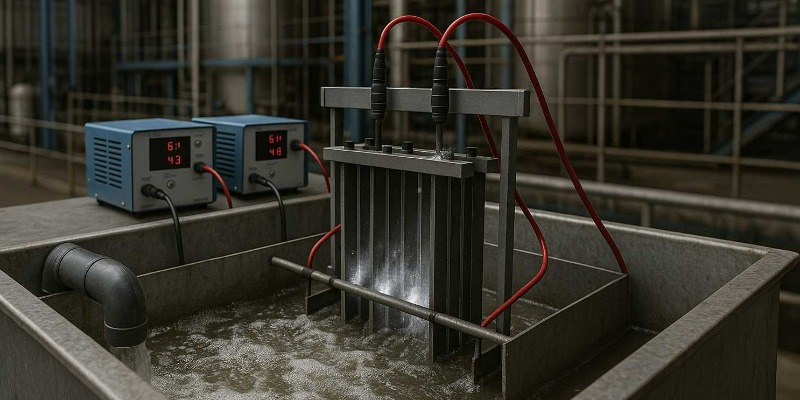





- What is electro-oxidation and how does it work in industrial wastewater treatment?
- Chemical and physical principles of the electro-oxidation technique
- Environmental and technical advantages of electro-oxidation in industrial processes
- Operational limitations and challenges of electrochemical wastewater purification
- Practical applications of electro-oxidation in the textile and pharmaceutical industries
- Electro-oxidation for the treatment of leachates and water containing heavy metals
- Technological innovations in electro-oxidation and new industrial prospects
- Electro-oxidation as a sustainable solution for wastewater treatment
An up-to-date, scientific guide to electro-oxidation techniques in industrial wastewater treatment, with analysis of benefits, limitations, and usage scenarios.
by Marco Arezio
Growing industrialization, coupled with the progressive scarcity of water resources, has made wastewater treatment a key issue in environmental sustainability. Industries, from chemical to pharmaceutical, from textile and tanning to food, generate enormous volumes of wastewater rich in complex contaminants every day, often not easily degradable with traditional technologies. In this context, scientific research has seen a strong push in recent decades towards advanced purification methods, among which electro-oxidation (EO) stands out.
This process currently represents one of the most promising frontiers in industrial water treatment, as it allows the reduction of a wide range of recalcitrant pollutants, reducing the need for chemical reagents and promoting circular resource management.
Scientific principles of electro-oxidation
Electro-oxidation is based on advanced oxidation phenomena that occur through the application of an electric current in an electrochemical reactor, where wastewater serves as the electrolyte. The process takes place inside cells consisting of two or more electrodes (cathode and anode), generally made of corrosion-resistant materials such as titanium coated with metal oxides, platinum, boron-doped diamond (BDD), or graphite.
When current is applied, water molecules near the anode are oxidized, generating extremely reactive hydroxyl radicals (•OH). These radicals can attack and mineralize a wide range of organic pollutants, progressively transforming them into less hazardous species such as CO₂, H₂O, and mineral salts. Furthermore, electro-oxidation can induce the formation of other secondary oxidants, such as active chlorine, when chloride ions are present in the water.
The process can be conducted directly, by attaching the pollutant to the anode, or indirectly, through the in-situ generation of secondary oxidizing agents. The choice depends on both the nature of the pollutants and the composition of the aqueous matrix being treated.
Technical and environmental advantages of electro-oxidation
The electro-oxidation technique has numerous advantages over conventional purification methods, both chemical and physical-biological.
Versatility and broad applicability: Thanks to its non-selective nature, the process is able to act on a wide variety of organic and inorganic compounds, including dyes, surfactants, pesticides, drugs, phenols, polycyclic aromatic hydrocarbons (PAHs), and many other emerging contaminants that are often resistant to biological treatments.
High abatement efficiency: EO often allows for complete mineralization of pollutants, up to the total removal of the organic load (COD and TOC), avoiding the formation of toxic secondary by-products.
Reduced chemical use: By not requiring external oxidizing reagents such as permanganate, chlorine, or hydrogen peroxide, EO minimizes procurement costs and chemical sludge generation, while reducing environmental impact.
Real-time control: adjusting the applied current allows for precise control of the process and its intensity, adapting the purification process to the actual pollutant load of the water to be treated.
Integration possibilities: electro-oxidation can be easily integrated into existing plants as tertiary or advanced treatment, improving the purification level without the need for significant infrastructure modifications.
Limitations and operational challenges of the technique
Despite its numerous advantages, electro-oxidation also presents some limitations and operational criticalities that affect its large-scale diffusion.
Energy consumption: Process efficiency depends heavily on the conductivity of the solution, the nature of the electrodes, and the applied current. In large-scale systems or with low-conductivity wastewater, electricity consumption can represent a significant cost.
Formation of by-products: in the presence of high concentrations of chloride ions, chlorates and perchlorates may be generated, compounds that are undesirable for human health and the environment, which may require post-treatment phases.
Electrode degradation: Depending on the material used, the anode electrode can be subject to corrosion or passivation, impacting the system's lifespan and efficiency. However, research is offering increasingly high-performance solutions, such as the use of boron-doped diamond (BDD) anodes, which exhibit exceptional resistance and selectivity.
Scalability: Although the technology is extensively tested in laboratories and small pilot plants, its widespread adoption requires further technical optimization and a reduction in capital costs.
Industrial applications of electro-oxidation
The versatility of electro-oxidation allows its application in numerous industrial sectors, both as a primary treatment and as a water refinement after traditional biological processes.
Textile industry: one of the most widely used areas is the treatment of wastewater containing synthetic dyes and surfactants, which are often difficult to biologically degrade. EO allows for the rapid destruction of pigments and a reduction in toxicity, facilitating water reuse in a circular economy context.
Pharmaceutical and chemical industries: The presence of recalcitrant micropollutants, such as antibiotics and solvents, poses a significant challenge to conventional treatment systems. Electro-oxidation has proven effective in breaking down these compounds, ensuring advanced wastewater purification prior to discharge or reuse.
Landfill leachate treatment: Leachate, rich in organic matter and ammonia, is difficult to treat with traditional processes. EO, potentially combined with other technologies (reverse osmosis, activated carbon adsorption), represents an effective solution for reducing pollutant load and preventing environmental contamination.
Food and dairy industries: even in these sectors, where wastewater contains high concentrations of organic matter, electro-oxidation can be used as a final treatment to reduce chemical oxygen demand and ensure compliance with regulatory discharge limits.
Treatment of water containing heavy metals: the technique is also used to remove metallic species through electrodeposition and co-precipitation, contributing to the reduction of ecotoxicological risks.
Innovations and future prospects
Electrooxidation is a rapidly developing field, the subject of intense scientific research and experimental applications. Recent advances in electrode design, the development of modular reactors, and synergistic combinations with other advanced processes (photocatalysis, electrochemical Fenton, ozonation) are making the technology increasingly competitive and sustainable.
Research today aims to reduce energy costs through the use of renewable sources (photovoltaic, wind), to improve efficiency with new electrocatalytic materials and to develop "smart" systems capable of automatically adapting to variations in the polluting load.
In the coming years, growing regulatory attention to emerging contaminants and the need to meet increasingly stringent quality standards are expected to further boost the industrial adoption of electro-oxidation, particularly in sectors where water reuse is strategic for competitiveness and environmental sustainability.
Conclusion: towards an increasingly sustainable purification
Electro-oxidation technology currently represents a cutting-edge solution for the sustainable management of industrial wastewater. Thanks to its ability to reduce even the most stubborn contaminants without the extensive use of chemicals, it offers a concrete solution to the needs of environmental protection and water resource circularity. Although some operational challenges remain, the development prospects and ongoing innovations make electro-oxidation a technology to follow with great interest in the coming years, for both businesses and researchers and environmentally conscious policymakers.
© Reproduction Prohibited